
Christopher “Kit” Carson (1809-1868) was born in Kentucky. As a teenager, he was apprenticed to a saddle maker but soon found the business was not to his liking. This led him to run away from his home in Franklin, Missouri, at the age of sixteen and join a group of trappers on their way to Santa Fe. Carson helped take care of the livestock as they traveled.
By 1826, he had settled in Taos, New Mexico, living with Matthew Kinkead, a trapper who had served with Carson’s older brothers during the War of 1812. Kinkead tutored Kit, teaching him to be a skilled trapper. Though he dabbled in several trades, he was trapping full time by 1829 and had signed on with Ewing Young’s brigade.
In 1831, Tom Fitzpatrick was late in submitting his order for goods and had to accompany Jedediah Smith, William Sublette and David Jackson to Santa Fe to get supplies. While in New Mexico, he recruited Carson to work for the Rocky Mountain Fur Company (RMFC).
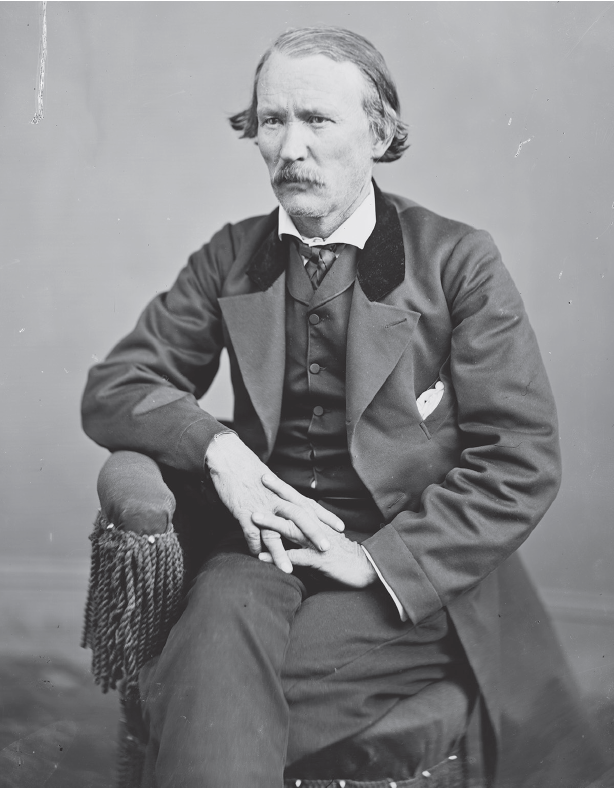
For more than a decade (1829–1840), Carson trapped beaver across nearly every major western territory, including present-day Colorado, Wyoming, Utah, Idaho, and Montana. He came to lead trapping parties of up to 60 men, establishing a reputation for competence and toughness within the mountaineer community. When RMFC went out of business, he worked for the American Fur Company until the last days of the rendezvous system in 1840.
Carson was fluent in Spanish and at least eight Native American languages, including Navajo, Apache, Cheyenne, and Arapaho, as well as Plains Indian sign language. This made him an essential intermediary for trade, negotiations, and maintaining fragile peace between trappers and various tribes. Unlike many who viewed the West as strictly a resource, Carson integrated into the Native world by marrying Waanibe, an Arapaho woman, and later a Cheyenne woman. These alliances provided him with deep cultural knowledge and protected trade access that purely commercial traders lacked.
As the beaver trade collapsed, Carson helped pioneer the next phase of the industry by becoming a professional hunter for Bent’s Fort. He supplied thousands of pounds of buffalo, antelope, and deer meat to the largest trading post on the Santa Fe Trail, keeping the commercial hub viable as it shifted from furs and bison robes to overland trade.
Carson’s extensive knowledge of the Rockies—gained through years of trapping—caught the attention of John C. Fremont, who hired Carson as a guide for his exploring expeditions. It was Carson’s eye for water, grass, and mountain passes that allowed Fremont to map the Oregon Trail, effectively ending the fur trade era by opening the mountains to mass settlement.
RECOMMENDED READING
Harvey Lewis Carter, Dear Old Kit: The Historical Christopher Carson (1968; Norman, OK: University of Oklahoma Press, 1990).
Thelma S. Guild and Harvey L. Carter, Kit Carson: A Pattern for Heroes (Lincoln, NE: University of Nebraska Press, 1988).