
By Museum of the Mountain Man Staff
Celebrating Christmas in the remote reaches of the Rocky Mountains required creativity, and sometimes a bit of improvisation. Fur trade journals offer glimpses into how trappers, traders, and their Native neighbors adapted familiar traditions to unfamiliar landscapes. One of the most vivid accounts comes from Rufus B. Sage, who described a remarkably festive Christmas dinner crafted from whatever resources the camp could gather.
Towards the end of November 1841, Sage, a member of a party employed by Lancaster P. Lupton, set out from the company’s Fort Lancaster on the South Fork of the Platte River in hopes of trading with the Brule Sioux. On Chadron Creek, a few miles from its confluence with the Upper White River (in present northwestern Nebraska), the men planned to build cabins for their winter quarters.1 From the newly constructed lodging, Sage wrote:
Dec. 25th. Christmas finds us in our new residence, which, with the exception of a chimney, is now completed.
This great annual festival is observed with all the exhilarating hilarity and good cheer that circumstances will allow. Several little extras for the occasion have been procured from the Indians, which prove quite wholesome and pleasant-tasted. One of these, called washena, consists of dried meat pulverized and mixed with marrow; another is a preparation of cherries, preserved when first picked by pounding and sun-drying them, (they are served by mixing them with bouillie, or the liquor of fresh-boiled meat, thus giving to it an agreeable winish taste;) a third is marrow-fat, an article in many respects superior to butter; and, lastly, we obtained a kind of flour made from the pomme blanc, (white apple,) answering very well as a substitute for that of grain.
The above assortment, with a small supply of sugar and coffee, as well as several other dainties variously prepared, affords an excellent dinner, — and, though different in kind, by no means inferior in quality to the generality of dinners for which the day is noted in more civilized communities.2 [Emphasis in original.]
Despite the isolation of winter camp, Sage and his companions found ways to make the day special. Their celebration blended “procured goods” and the skills of the diverse people around them. It was not the Christmas feast they might have known back home, but it was a feast nonetheless, and one made meaningful by the effort and cooperation involved.
Accounts like Sage’s show how Christmas in the fur trade was shaped by both location and circumstances. At major posts, celebrations might include abundant meals, music, dancing, or occasional rowdiness. In small winter camps, the holiday became a communal effort, with trappers, traders, and Native or Métis families improvising meals, songs, and games from limited supplies.
These gatherings highlight how mobility, scarcity, and cultural diversity influenced holiday traditions on the frontier. By sharing labor, blending customs, and celebrating with whatever was at hand, fur trade communities created hybrid holidays that preserved identity while fostering intercultural cooperation.
Whether in a bustling fort or a snowy mountain camp, Christmas offered a rare respite from the hardships of the fur trade—a moment to pause, connect, and find joy in the rugged landscape they called home.
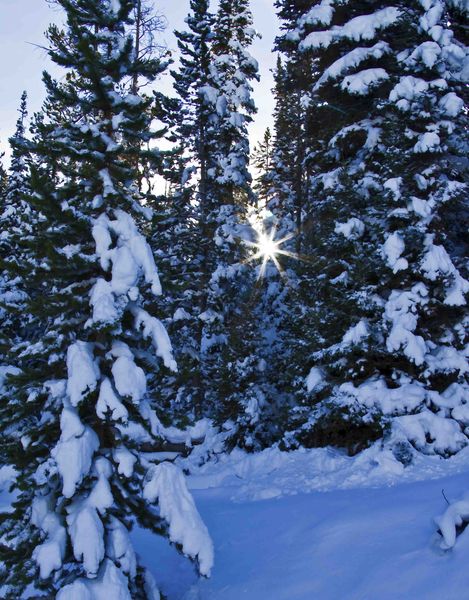
All images courtesy of Dave Bell – Wyoming Mountain Photography.
- Charles E. Hanson, Jr. and Veronica Sue Walters, “The Early Fur Trade in Northwest Nebraska,” Nebraska History 57 (1976): 291-314. ↩︎
- Rufus B. Sage, Rocky Mountain life: or, Startling Scenes and Perilous Adventures in the Far West during an Expedition of Three Years (Boston: Wentworth & Company, 1857), 113. ↩︎