
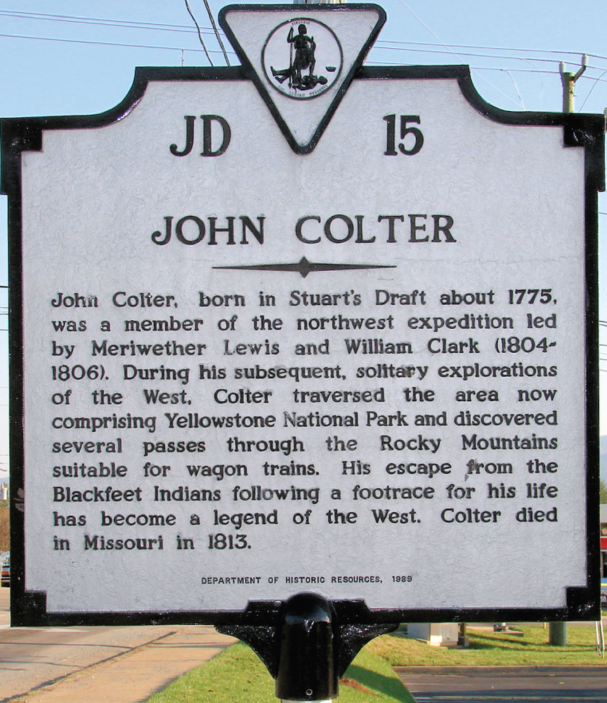
John Colter is widely recognized as one of the first “mountain men” of the Rocky Mountain West. In many ways, his transition from a soldier on the Lewis and Clark Expedition to a solo trapper and explorer laid the groundwork for the entire Rocky Mountain fur trade. He was deemed invaluable on that Expedition and its leaders credit him with much of the venture’s success.
Colter demonstrated early on that an individual could survive and operate independently in the deep wilderness. In 1806, he famously requested an early discharge from the Lewis and Clark Expedition to join two trappers, effectively choosing the life of a trapper over a return to civilization. He spent the next winter along Clarks Fork of the Yellowstone River.
Colter played a critical role in the first organized commercial efforts in the Rockies. He joined with Manuel Lisa in 1807 to build Fort Raymond (also known as Fort Manuel) at the confluence of the Bighorn and Yellowstone Rivers. This was the first major base for the Missouri Fur Company.
Lisa tasked Colter with traveling over 500 miles alone to find tribes and inform them of the new trading post. His ability to negotiate and foster these early trade relationships was essential for the commercial success of the upper Missouri region.
During this solo winter journey in 1807-1808, Colter became the first person of European descent to see and describe the geothermal wonders of today’s Yellowstone National Park and what is now the Grand Teton Mountain Range. His reports of steaming geysers and bubbling mud pots were initially met with disbelief and derided as “Colter’s Hell.” This extensive traversing of the Rocky Mountains alone—and surviving—demonstrates the wilderness skills Colter possessed.
In 1810 he guided a party led by Andrew Henry to the Three Forks area of the Missouri River. Henry built a fort as a base for an ill-fated trapping endeavor wherein eight trappers were killed by the Blackfeet within two months (including the estimable George Drouillard, another member of the Lewis and Clark Expedition). Henry abandoned the fort and took a brigade south into what is now Idaho. Colter decided not to press his luck any further and led a group back to St. Louis where he provided William Clark with detailed descriptions of his travels. This information was incorporated into Clarks famous 1810 “manuscript” map, which served as the most accurate geographical guide for the Rocky Mountains for the next 75 years.
The legend of “Colter’s run” is one of the great stories of the Fur Trade Era. In 1808, after being captured by Blackfeet Indians, Colter was stripped naked and forced to literally run for his life. His miraculous escape and 200-mile trek back to Fort Raymond became a founding myth of the fur trade. This event also highlighted the extreme dangers of not only the Three Forks area, but mountain life overall.
RECOMMENDED READING
Burton Harris, John Colter, His Years in the Rockies (New York, NY: Charles Scribner’s Sons, 1952). Buy now.
Ronald M. Anglin and Larry E. Morris, Gloomy Terrors and Hidden Fires, The Mystery of John Colter and Yellowstone (New York, NY: Rowman & Littlefield, 2014). Buy now.