
William H. Ashley (ca. 1778–1838), a Virginian by birth, was a pivotal figure in the Rocky Mountain fur trade. Under his leadership, the industry transformed from a river-based trade with Native Americans into a systematic, American-led mountain venture. Ashley revolutionized the fur business by moving away from fixed-site trading posts when he established the Rocky Mountain rendezvous system of supplying trappers, allowing those men to stay in the mountains year-round.
Ashley was active in the Missouri Territorial Militia and during the War of 1812 advanced to Lieutenant Colonel of a regiment with Andrew Henry as his Major. In 1821, Ashley reached the rank of Brigadier General of the militia, acquiring the title of “General” by which he was often known. His role as an officer provided him with first-rate leadership skills. Ashley used these campaign skills to operate the overland caravans in a quasi-military fashion for safety and effectiveness. The methods he introduced for travel and camping from 1822 to 1826 when he led men to and from the mountains became the standard for many brigade leaders.
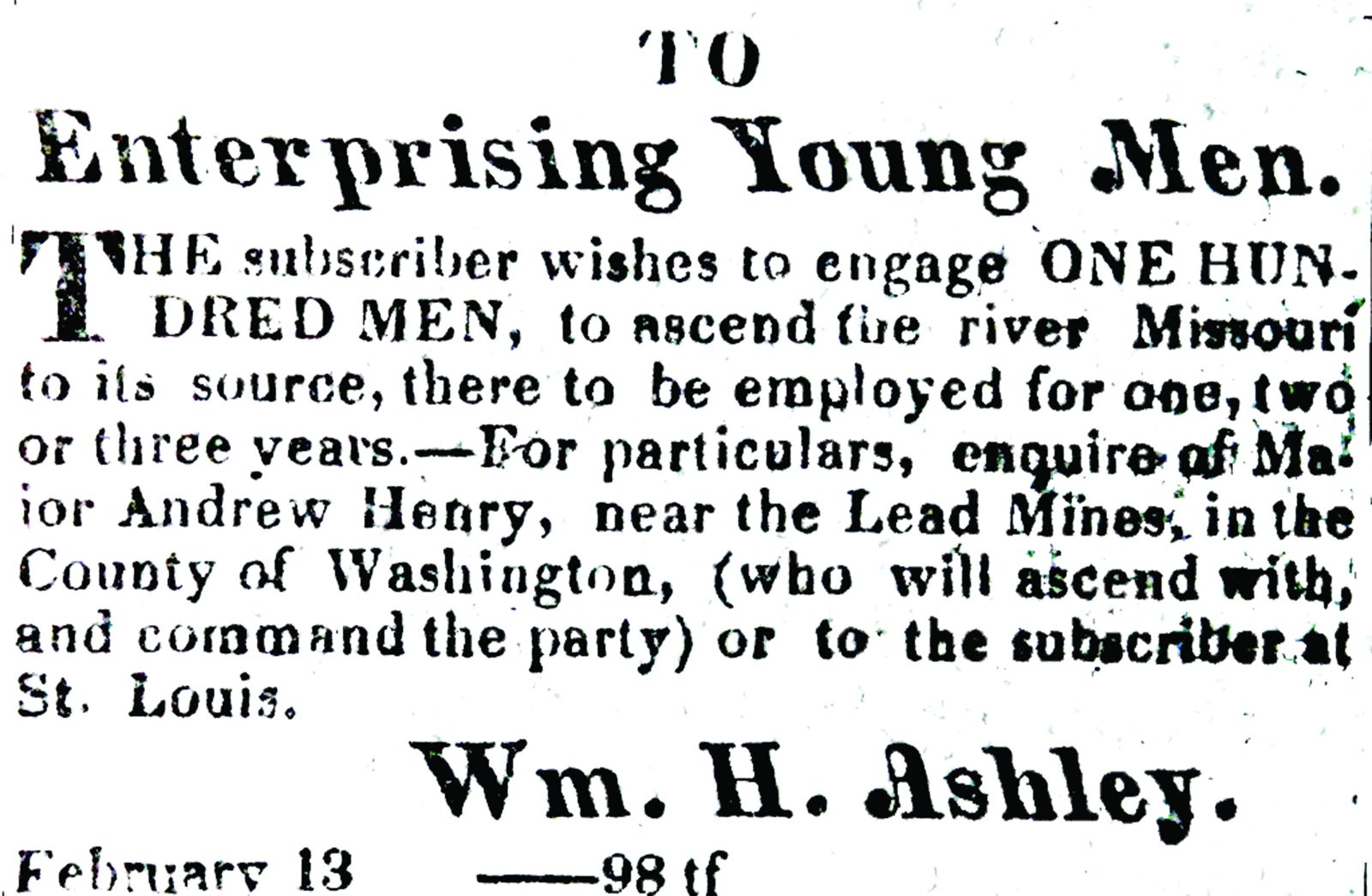
In 1822, Ashley and his partner Andrew Henry recruited “one hundred enterprising young men” to staff the Henry & Ashley Fur Company. This group of employees included legendary individuals such as Jedediah Smith, Jim Bridger, Tom Fitzpatrick, and Hugh Glass. These “Ashley men,” and many others, would play key roles in advancing the expansion of America’s boundaries as they explored the West in search for fur-bearing animals.
Other innovations included a novel approach to how mountaineers were paid. Trappers could become “company men,” receiving all their gear and a wage, but their entire harvest of beaver pelts went to the boss. Another option was to trap on “shares,” meaning they got some of their equipment from management, but their salary was keeping a portion of the skins they garnered each season. The final option was to become a “free trapper.” This breed of mountain man provided all of his own supplies, including traps, horse, gun, etc., but could trade his catch with whomever offered him the best deal.
Ashley’s shift to land-based supply routes not only reduced the trade’s reliance on dangerous river navigation, but the expeditions he and his crew made in their hunts explored new regions of the Rocky Mountain West. What eventually developed was a summertime fur trading fair known as the rendezvous. This was a system to provide men in the field with equipment while acquiring the furs they had harvested without substantially interrupting the annual cycle of the mountaineers’ work. A significant result was the use of South Pass which would become an important corridor for future Emigrant Trail use.
Although Ashley was not himself a long-term mountain trapper, it was his foresight, organization, and leadership that made the Rocky Mountain fur trade a success, securing his place as one of the most consequential architects of western expansion.
RECOMMENDED READING
Richard M. Clokey, William H. Ashley; Enterprise and Politics in the Trans-Mississippi West (Norman, OK: University of Oklahoma Press, 1980).
Donald McKay Frost, General Ashley, The Overland Trail and South Pass (Barre, MA: Barre Gazette, 1960).