
Two hundred years ago this month—April 1826—the Rocky Mountain fur trade was in its prime. Demand for felt hats in the eastern United States and Europe was strong, and American trapping brigades pushed ever deeper into the West. They competed fiercely not only with one another but also with the Hudson’s Bay Company (HBC).
Most trappers had spent the previous months in the relative quiet of winter camps. But across the West in April 1826, men were on the move. Spring was one of the best trapping seasons of the year, and brigades wanted to take advantage of pelts still thick from winter growth and waterways finally open enough to set traps along banks and channels. Two significant events that month would shape the season.
Ashley’s Relief Expedition Reaches Jedediah Smith
While trappers prepared for spring hunts, supply lines far to the east were struggling in the harsh winter.
In October 1825, William Ashley and his new partner, Jedediah Smith, returned to St. Louis, Missouri and immediately began organizing a new supply train.[1] Ashley remained in St. Louis to manage the partnership’s business affairs, while Smith quickly departed again for the mountains –late in the season.[2]
Accompanying him was Robert Campbell, who was starting what would become a long and profitable fur trade career. Around sixty or seventy men managed a pack string of about 160 mules.[3] Campbell later remarked, “We left St. Louis on the first of November. It was wrong to start at that season, because we had the winter to encounter.”[4]
The winter of 1825-1826 was severe on the prairie, as snow blanketed the plains and covered the grass that pack animals depended upon. Deteriorating conditions and a lack of forage and supplies forced Smith’s caravan to halt on the Republican Fork of the Kansas River. Nearly a third of the horses and mules were lost to starvation. Morale suffered, and exposed to cold and uncertainty, nearly half of Smith’s men eventually deserted. Facing the collapse of the expedition, Smith dispatched Jim Beckwourth and Moses “Black” Harris back to St. Louis with an urgent appeal for help.[5]
Ashley responded quickly. His relief expedition left in mid-March 1826 and caught up with Smith near present-day Grand Island, Nebraska, on the Platte River by the end of April.[6] Ashley noted in his diary, “Went & brought up the Party of M Smith opposite the Encampment on the 24th.”[7] The meeting came none too soon: Smith’s reduced company was in no condition to continue.[8] (For more on Smith and Campbell’s winter on the Republican Fork and Ashley’s Journal, see “William H. Ashley’s Newly-Discovered 1826 Fur Trade Journal” in The Rocky Mountain Fur Trade Journal, Volume 8, available here.)
With fresh men, horses, and mules, Ashley altered the plan. He directed Smith and Harris to press ahead to the mountains to inform the brigades that supplies were on the way.[9] Ashley then pushed the reinforced train up the Platte, toward South Pass, and on to the Bear River and the upcoming rendezvous.[10]
In April 1826, after a winter marked by hunger, desertion, and loss, the fur trade enterprise of Smith and Ashley was back on track, and the supply line—vital to the mountain men’s success—was restored just in time for the summer rendezvous in Willow Valley, modern day Cache Valley, Utah.[11].
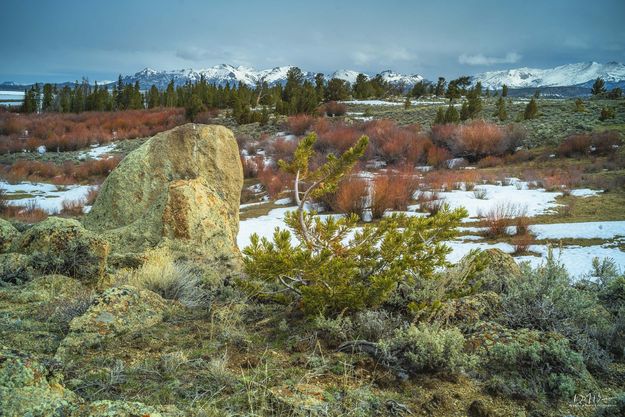
Ogden Meets the Americans–Again
Meanwhile, another April encounter was unfolding farther west.
Peter Skene Ogden of the Hudson’s Bay Company (HBC) entered the spring of 1826 with unfinished business. The previous year, he had suffered defeat and humiliation in the Snake Country at the hands of Johnson Gardner and a party of American trappers.[12] (This dramatic encounter is explored in “‘Now We Go’: Snake Country Freemen and the Desertions of May 1825” in The Rocky Mountain Fur Trade Journal, Volume 12, available here.) He had lost freemen to desertion, endured taunts, and left the region.[13] Editor E.E. Rich wrote that “after his brush with the Americans under Gardner in 1825, he seems to have become allergic to them.”[14]
Yet in 1826, Ogden once again found himself in charge of the HBC’s Snake Country Brigade.[15] Despite any personal misgivings, he was moving directly back toward the scene of the previous year’s humiliation, and toward renewed competition with the Americans.
When American winter camps broke up toward the end of February, several trapping parties were formed. One of these parties included a number of HBC deserters from the previous year.[16] It was, of course, this group that soon crossed paths with Ogden’s brigade.
In March, Ogden received reports from Native sources that a party of Americans and Iroquois was no more than three days’ march from his camp on the Portneuf River, a development he did not welcome.[17] On March 20, 1826, he wrote, “I dread meeting with the Americans.”[18] Memories of the 1825 encounter with Johnson Gardner’s brigade were still fresh and likely came with more than a little apprehension.
By Sunday, April 9, 1826, Ogden’s fears were realized when he was “surprised by the arrival of a party of Americans and some of our deserters of last year, 28 in all.”[19] Although Ogden never named the leader of the American party, it appears that Jim Bridger and Thomas Fitzpatrick may have been among its members.[20] Reflecting in his journal, Ogden noted, “if we were surprised they were more so from an idea that the threats of last year would have prevented us from returning to this quarter, but they find themselves mistaken.”[21]
The encounter, however, unfolded very differently from the tense confrontation of 1825. Ogden recorded:
The strangers paid me a visit and I had a busy day settling with them, and more to my satisfaction and the company’s than last year … our deserters are already tired of their new masters and from their manner will soon return to us.[22]
In fact, some of the deserters reportedly promised to return to the HBC’s Flathead Post in the fall, a development that must have been sweet vindication for Ogden.[23] Just as important, he noted with evident pride that “not one of our party appeared the least inclined to desert; so much to their credit.”[24]
For Ogden, the meeting of April 9, 1826, marked a reversal of fortune. Two hundred years ago this month, a confrontation he had dreaded instead restored his confidence.
Two Hundred Years Later: A Bicentennial Moment
Two hundred years ago this month, the Rocky Mountain fur trade reached a noteworthy moment. Ashley’s relief expedition finally caught up with Smith after a punishing winter had stalled men, animals, and determination alike, while Ogden faced American rivals in Snake Country—what could have been a bitter confrontation instead ended in satisfaction for Ogden and the HBC. These events capture the trade at its height: fierce rivalries, fragile supply lines, shifting loyalties, and endurance tested by distance and winter. In April 1826, timing, preparation, and a bit of luck mattered as much as beaver pelts themselves.
[1] LeRoy R. Hafen, ed., “A Brief History of the Fur Trade in the Far West,” in The Mountain Men and the Fur Trade of the Far West, vol. 1 (Glendale, CA: The Arthur H. Clark Company, 1965), 83–84.
[2] Dale L. Morgan, ed., The West of H. William Ashley, 1822–1835 (Denver: Fred A. Rosenstock, The Old West Publishing Company, 1964), 143.
[3] William R. Nester, From Mountain Man to Millionaire: The “Bold and Dashing Life” of Robert Campbell (Columbia, MO: University of Missouri Press, 2011), 17.
[4] Morgan, ed., West of William Ashley, 143.
[5] Nester, From Mountain Man to Millionaire, 17-18.
[6] Ibid., 18.
[7] Dr. Jay H. Buckley, “William H. Ashley’s Newly-Discovered 1826 Fur Trade Journal,” The Rocky Mountain Fur Trade Journal, 8 (2011):25.
[8] Morgan, West of William Ashley, 143-144.
[9] Ibid., 144.
[10] Ibid.
[11] Fred R. Gowans, Rocky Mountain Rendezvous: A History of the Fur Trade Rendezvous, 1825–1840 (Layton, UT: Gibbs M. Smith, Inc., 1985), 64.
[12] Thomas H. Holloway, “‘Now We Go’: Snake Country Freemen,” The Rocky Mountain Fur Trade Journal, 12 (2018): 56–59.
[13] Ibid.
[14] E. E. Rich, ed., “Peter Skene Ogden’s Snake Country Journals, 1824-26” (London: Hudson’s Bay Record Society, 1950), lvi-lix, 154-155.
[15] Peter Skene Ogden, “Journal of the Snake Country Expedition, 1825–1826,” T. C. Elliott, ed., Oregon Historical Quarterly 10, no. 4 (1909):335.
[16] Morgan, West of William Ashley, 146.
[17] Ibid.
[18] Ogden, Snake Country Journals, 1824–26, 144.
[19] Ogden, “Journal of the Snake Country Expedition,” 359.
[20] Harrison C. Dale, “The Ashley-Smith Explorations and the Discovery of a General Route to the Pacific” (Glendale, CA: Arthur H. Clark, 1941), 162-163.
[21] Ogden, “Journal of the Snake Country Expedition,” 359.
[22] Ibid., 359-60.
[23] Ibid.
[24] Ibid.