
$30.00
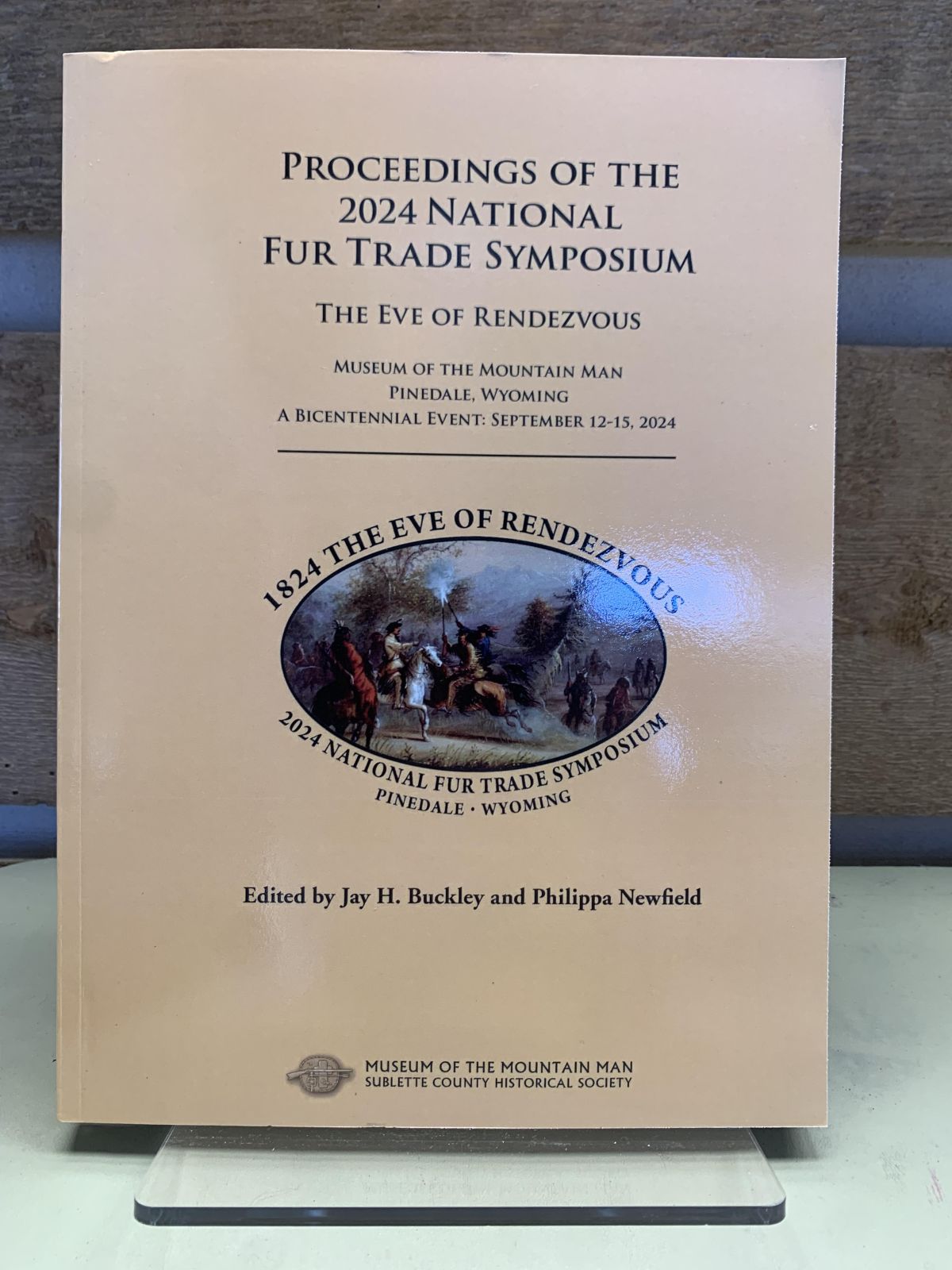
Proceedings of the 2024 National Fur Trade Symposium – The Eve of Rendezvous
Museum of the Mountain Man Pinedale, Wyoming. A Bicentennial Event September 12-15, 2024
Full color, perfect bound, 8″ x 11″, softback, 178 Pages
Description
Proceedings of the 2024 National Fur Trade Symposium – The Eve of Rendezvous
Museum of the Mountain Man Pinedale, Wyoming. A Bicentennial Event September 12-15, 2024
A Swirling Mass of Humanity: Migration, Exploration, and Trade before the Rendezvous
by James A. Hanson
The 1823-1824 Enterprise of Jedediah Smith’s Fur Brigade: Arikara Resistance, Crow Friendship, and the Rediscovery of South Pass
by Jay Buckley & Steve Banks
This presentation analyses the changes in the 1820s that enabled Andrew Henry and William Ashley to form a fur company partnership. They chronicle Henry-Ashley’s attempts to trade for furs along the Missouri River but face disaster and Arikara warriors. Ashley sends Jedediah Smith to the Crows on the Wind River while he returned to St. Louis. They trace Smith’s route from his winter encampment at Dubois to his rediscovery of South Pass in 1824. Meanwhile, Thomas Fitzpatrick conveyed the news to Ashley while Smith and his men crossed into the Green River Valley to trap. These developments combined to make the Rendezvous era
possible.
Who Led the First Trappers Across South Pass in 1824: Jedediah Smith or Thomas Fitzpatrick?
by Clay Landry
Historians Hiram Chittenden and Harrison Dale published that the Henry/Ashley party that first crossed South Pass into the Green River Valley in 1824 was led by Thomas Fitzpatrick. However, Charles Camp editing James Clyman’s journals states Jedediah Smith was the leader. South Pass’s re-discovery issue originates via the scholarly endeavors of three esteemed fur trade historians. Consequently, this essay will apply a historiography approach to determine the accurate facts of this debate.
John Henry Weber and his Trappers Explore Green River and Beyond
by Jerry Enzler
Jedediah Smith’s party gets much of the glory, but John Henry Weber and his men, including Jim Bridger, were integral in the discoveries of 1824-25. They explored Bear River & viewed Great Salt Lake, were involved in the defection of Iroquois trappers from HBC, brought the largest number of beaver pelts to the 1825 rendezvous, and navigated Bad Pass.
The Evolution of Rendezvous System
by Jim Hardee
William H. Ashley is generally given credit for establishing the concept of annual gatherings of trappers to trade their beaver harvest for supplies needed for future hunts. This paper examines how that idea grew out of trade fairs from the past, present and future of Ashley’s initial Rocky Mountain rendezvous.
The Use and Distribution of Elk Hide Lodges
by Bradley C. Bailey
In Laubin’s classic and often cited guide to Indian Tipis he states “In the early days all tipis were made of buffalo hides.” The image of the buffalo covered plains and Rocky Mountains belies the use of any other material for Native American skin lodges. This presentation will examine the evidence for the use of elk hides for lodges among Native American tribes in the Rocky Mountains as well as the Plains. It builds upon research collected over the last decade, using more than three dozen sources showing evidence more than 14 tribes used elk hides for tipis. It is entirely new research on a topic that has never been thoroughly examined before.
‘Bust Head’ and ‘Tangle Foot’: A Modern Field Guide to the Alcohol of the Fur Trade Era
by Bill Gwaltney
For reasons normal and nefarious, during the Fur Trade, commerce involving Alcohol was damned and praised, subject to law, smuggling, and illicit manufacture. Going by a variety of “pet names,” the raw alcohol common in the Fur Trade was often called “Bust Head,” “Tangle Foot” or “Oh, Be Joyful!” During this period, alcohol use was quite common among many Americans. Journalist Jim Vorel, suggests that by 1830, alcohol consumption in the United States reached its peak at an amazing 7 gallons of distilled liquor per person. This study will explore the commerce of alcohol during the fur trade and detail specific types available to the Mountain Men and American Indians.
Feast and Famine: Dining with the Mountaineers
by Doyle Reid
An introduction to the demands of the Mountaineer’s vigorous lifestyle, and the challenge of providing required nutrition. Using their own words to describe food procurement, preparation, cooking and eating shine a light on this often overlooked but vital subject.
Andrew Henry: Icon of the American West
by Mark William Kelly
Andrew Henry is no less than an iconic figure in the annals of the American West. His name is rarely, if ever, omitted from the innumerable discourses touting the exploits of those early day Mountain Men, whose wilderness paths would soon be transformed into the crowded freeways of Manifest Destiny. Henry, however, is somewhat of an enigma. Multiple biographical sketches of the man exist, but it is rare to find any two possessing consistency as to the facts pertaining to the man. If not for the record of his exploits up the Missouri River and beyond, across the continental divide, Andrew Henry, quite likely, would have been lost to us all. It is my sincere desire that this newly published biographical book might serve to augment our appreciation
for the man. He certainly deserves to have his story truthfully told.
William Clark: Tripod Stool Geographer Or, How John Colter Found the Headwaters of the
Green River and Clark Lost Them
by Sheri Wysong
In 1912, Historian Hiram Chittenden wrote: “[Colter was] the first to cross the passes at the head of Wind River and see the headwaters of the Colorado of the West” Of course, Chittenden meant that Colter was the first European to do so; he likely used well established Indian trails in dropping down into the Upper Green River Valley. Since Chittenden, the only historian/biographer known to the presenter/author that indicated a possibility that Colter had been on the headwaters of the Green River was David Lavender. But analysis of William Clark’s 1810 manuscript and 1814 published maps indicates that Colter did indeed “cross the passes at the head of Wind River” and, if he was not actually the first European to cross South Pass, he definitely saw it. But Clark’s “Error of the Southwest” as called by Historian Bernard DeVoto, obscured the identity of the Green River and South Pass. The presentation uses both historical and Geographical Information System (GIS) maps that illustrate the Error of the Southwest, and how it lost Colter’s path through the Upper Green River Valley.
Horseless on Horse Creek: The Story Behind the Painting Depicting The Naming of Horse Creek
by Tim Tanner
Artist Tim Tanner has created an original painting depicting the story of Thomas Fitzpatrick and his small band of trappers having their horses stolen in the spring of 1824 on what has since been known as Horse Creek. It will be unveiled during the opening Symposium session, on display throughout the Symposium and will be a permanent part of the Museum of the Mountain Man collection. “Horseless on Horse Creek” is a 32”x60” oil painting depicting an important incident in the Spring of 1824, during one of the first occurrences of American Trappers methodically harvesting furs in the Green River Valley. In late Winter (1823-24), famed trapper Jedediah Smith led a party of about a dozen trappers westward through South Pass. He divided the party roughly in half at the Sweetwater River. Smith took half the men toward the south, and sent the remainder north. Around May, the northern party encountered a band of Shoshone, whom they befriended and gave beaver meat to eat. But when the Natives left the area, James Clyman, recounted that “our horses running (sic) loose on night they all disapeared (sic) and we were unable to find them or in what direction they had gone.” The mountain men continued trapping on foot – perhaps hoping their mounts would return. But after a time they must have surmised that their missing horses had either followed or were taken by the Shoshone. Having pre-arranged to meet up with Jed Smith and the southern party on June 10th at the Sweetwater River, Clyman informs us “accordingly we cashed (sic) traps & furs hung our saddle & horse equipments on trees & set out for Sweet water,” in an effort to retrieve the lost stock and meet up with Smith. Thus, a previously un-named beaver-filled stream—near its confluence with the Green River— gained a new, significant name. The location where they cached their furs and “hung saddles and horse equipments on trees” became known as “Horse Creek.”