
By Carol Kuhn
October 22, 2026
In the fall of 1824, Hudson’s Bay Company’s Alexander Ross reported the sickening of his trappers along a river that Ross subsequently named “Riviere Aux Malades.”[1] In his own words,
On reaching that stream we found beaver in considerable numbers. … but here a misfortune clouded our hopes and made beaver a secondary consideration. After breakfast the second morning, a number of the people were taken ill; and the sickness becoming general throughout the camp, it struck me that there must have been something poisonous in our food or water. Not being able to discover anything, I began to enquire more particularly what each person had eaten that morning, and found that all those who had breakfasted on the fresh beaver taken out of the river were affected, whilst those who had eaten other food remained in good health.…We then examined the flesh of the beaver, and found it much whiter and softer, and, the people who had eaten of it said, sweeter to the taste than the flesh of beaver generally. As there was no wood about the banks of the river, we supposed these animals must have lived on some root of a poisonous quality, which although not strong enough to destroy them, yet was sufficiently deleterious to injure us: from this it was that I named this stream Rivière aux Malades.[2]
Donald McKenzie wrote of a similar event in 1811, as did Peter Skene Ogden in 1825-1826, who noted in his journal that this “fine large stream; derives its name from the beaver living on a poisonous root.” He recollects that “in 1819, all who ate of the beaver taken here were seriously ill.”[3]
Robert Campbell’s brigade suffered the same fate in 1827.
One of my men caught a beaver. We had nothing to eat. My French Cook roasted the beaver. I ate a small piece to quiet my appetite, as I had had nothing to eat for a day or two. Just after I ate, I felt pains, as did all the others who ate it. The beavers were poisoned from eating the wild parsnip. Hence the name of the river,– Malad. Every one who ate these beavers were poisoned…. We had pains in the neck, head and other disagreeable sensations in the stomach and bowels. The old trappers knew what was the matter and attributed our sickness to eating poisoned beaver.[4]
The cause of this poisoning is a conundrum. The fur trappers themselves blamed a notoriously poisonous plant called water hemlock.[5] The assumption was that beaver living in areas with minimal woody vegetation were forced to eat tubers and roots, including those of water hemlock. The toxin, called cicutoxin, would then be passed on to the trappers via contaminated meat.
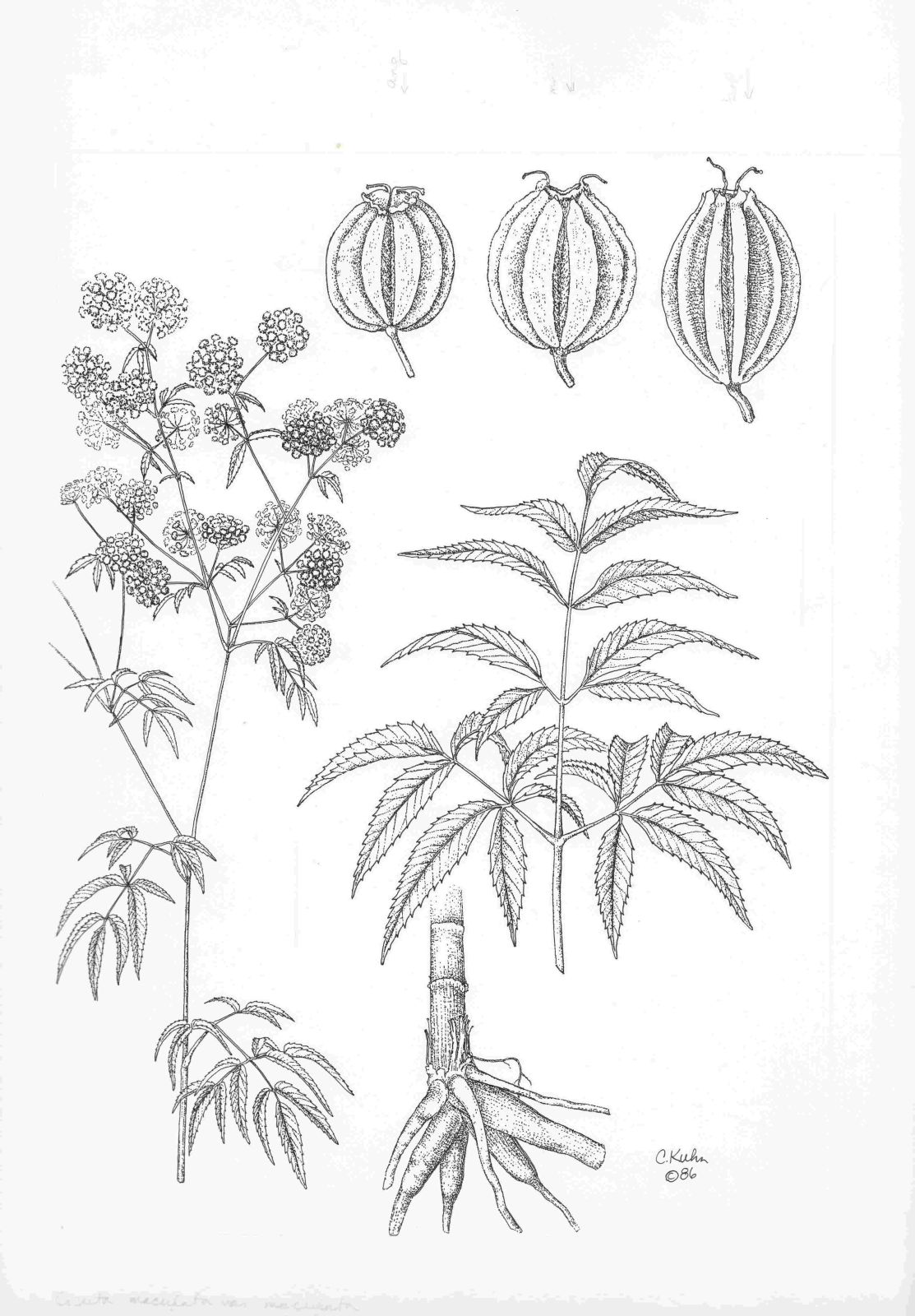
However, Dr. Benedict Green, Pharmacologist at the USDA-ARS Poisonous Plant Research Lab, thinks that that scenario is unlikely, because cicutoxin is an unstable molecule that degrades quickly.[6] Besides, since water hemlock is quickly lethal in even small amounts,[7] it is unlikely that the beaver would ingest a tuber or root and survive long enough to find its way to a trap or even care enough to investigate it.
Or was it something in the water? If that were the case, then perhaps the toxin would be in other aquatic organisms. However, Mr. Mike Sandifer, a professional trout fisherman who has fished the Malad for over 30 years, states that he has never become ill from water contact or from eating trout from that river.[8] Also, J. H. Stevens, as quoted by Warren A. Ferris, described being one of a group of parched trappers who fell upon the Malad River and drank profusely. While he does describe vomiting afterwards, he attributed that to over-indulgence, and no other symptoms occurred.[9]
But if the beaver were ingesting a far less lethal plant than water hemlock – one that would not cause immediate poisoning – then perhaps a toxin could bioaccumulate in their tissues over a period of time. But if that were the case, there should not be such an immediate reaction in the men who consumed them.
The chemical composition of plants varies based on a number of factors, including genetics, season, weather, soil, and geology. With that in mind, there is a strong likelihood that water hemlock varies in cicutoxin levels, such that the Malad River population might exhibit environmental or genetic reduction in the amount or strength of the toxin. After all, an isolated population of water hemlock in the steep Malad River canyon could evolve more quickly than one in a larger landscape, and perhaps that evolution would include a reduction in cicutoxin, especially if the primary herbivore target of that toxin is not present. Right? However, toxic beaver flesh was not restricted to one unlucky stream. It turns out there was not one, not two, but three rivers that harbored beaver that were toxic when consumed by hungry trappers, and thus were named “Malad,” and botanical records show water hemlock throughout southern Idaho. The three Malad Rivers are:
Malad River, Tributary of the Snake
This Malad River is located at the western edge of the Eastern Snake River Plain Aquifer in Oneida and Gooding Counties, Idaho. It is a right bank tributary of the Snake, joining that river west of Tuttle and I-84, and southwest of Gooding, Idaho. Today’s Malad River begins at the junction of Little and Big Wood Rivers[10] due west of Gooding, Idaho, and flows 12 miles through the Malad Gorge, a deep cut in the lava beds, to the Snake. But during the fur trade era, “Malad River” was much longer, as it included Big Wood River. Older USGS topographic maps concur. Idaho historian C. S. Walgamott affirmed this reduction in the run-of-river bearing the name Malad, noting that immigrants “in 1862 from the immense amount of poplars along the banks, called the streams Big and Little Wood River, which united near Gooding from whence the river still maintains its name [Malad] until it flows into the Snake river.”[11]
Donald McKenzie likely spoke of this Malad River when he described the 1811 trappers of the Pacific Fur Company [the Astorians] being stricken from eating beaver meat. Peter Skene Ogden camped on this Malad River in 1825-1826; he noted in his journal that this “fine large stream derives its name from the beaver living on a poisonous root.” Ogden talked about going over the steep divide between Goddin’s [today’s Lost] and Malad Rivers. He recognized this as the “fork of Salmon [Snake] River called by Mr. Ross Malad his men having been attacked with beaver illness.”[12]
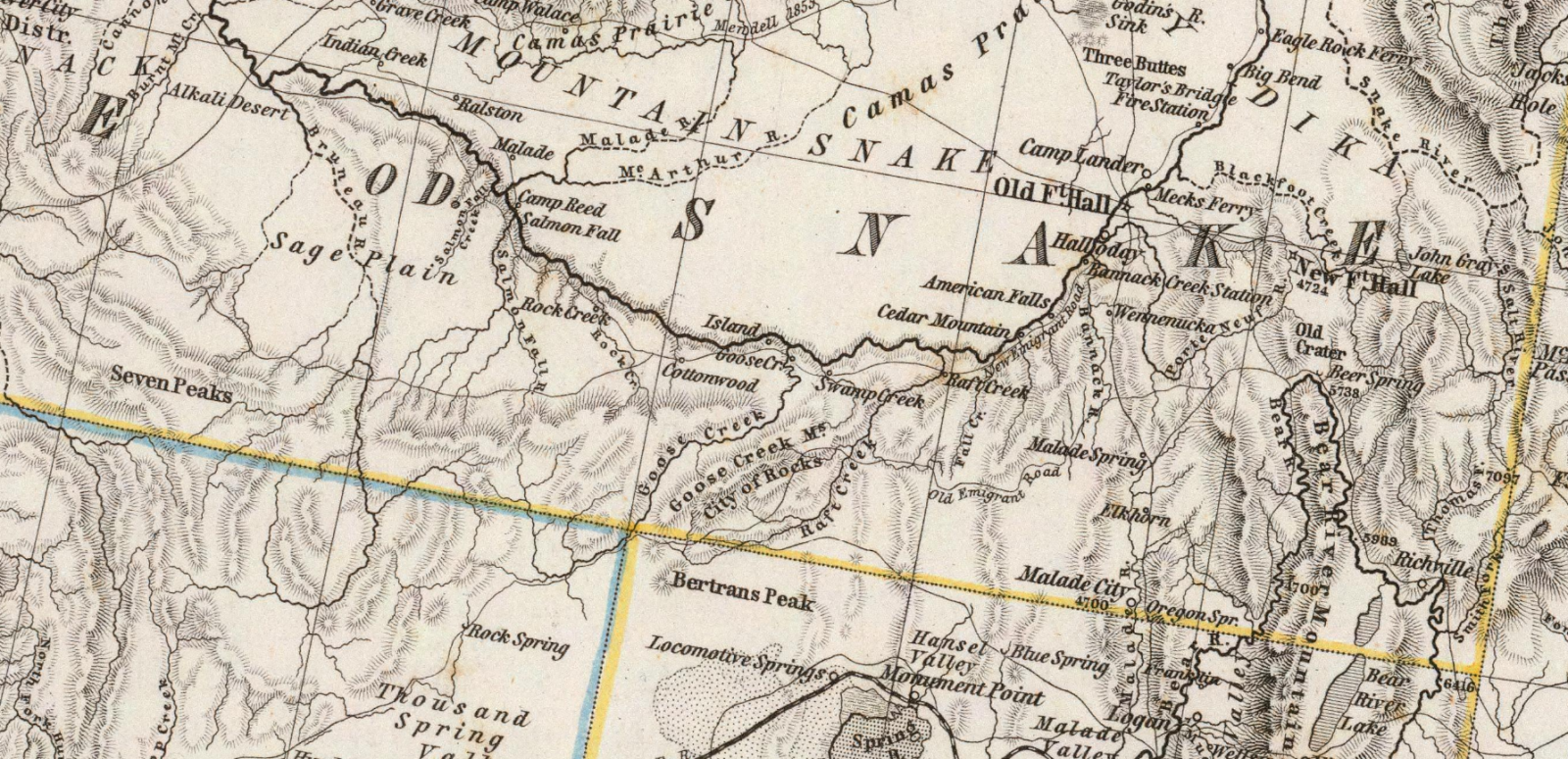
Image Courtesy of David Rumsey Map Collection. View the full map.
Malad River, Tributary of Bear River above Salt Lake
This Malad River flows through southeastern Idaho and northern Utah.[13] Its headwaters are in Big Malad Spring, northwest of Malad City, Idaho. This 97-mile right bank tributary empties into Bear River less than two miles south of Bear River City in Box Elder County, Utah. Bear River then enters the Great Salt Lake.[14] Warren Ferris describes this Malad River: “There is a small stream flowing into the Big Lake, the beaver taken from which, produce the same effect. It is the universal belief among hunters, that the beaver in these two streams feed upon some root or plant peculiar to the locality, which gives their flesh the strange quality of causing such indisposition.” Assuming Fayel’s Robert Campbell narrative is chronological, this is likely the Malad River described by Campbell, on his way from Wisdom River (today’s Big Hole River) to winter in Cache Valley.[15]
Malad River in Camas Prairie, Elmore County, ID, north of Mount Bennett
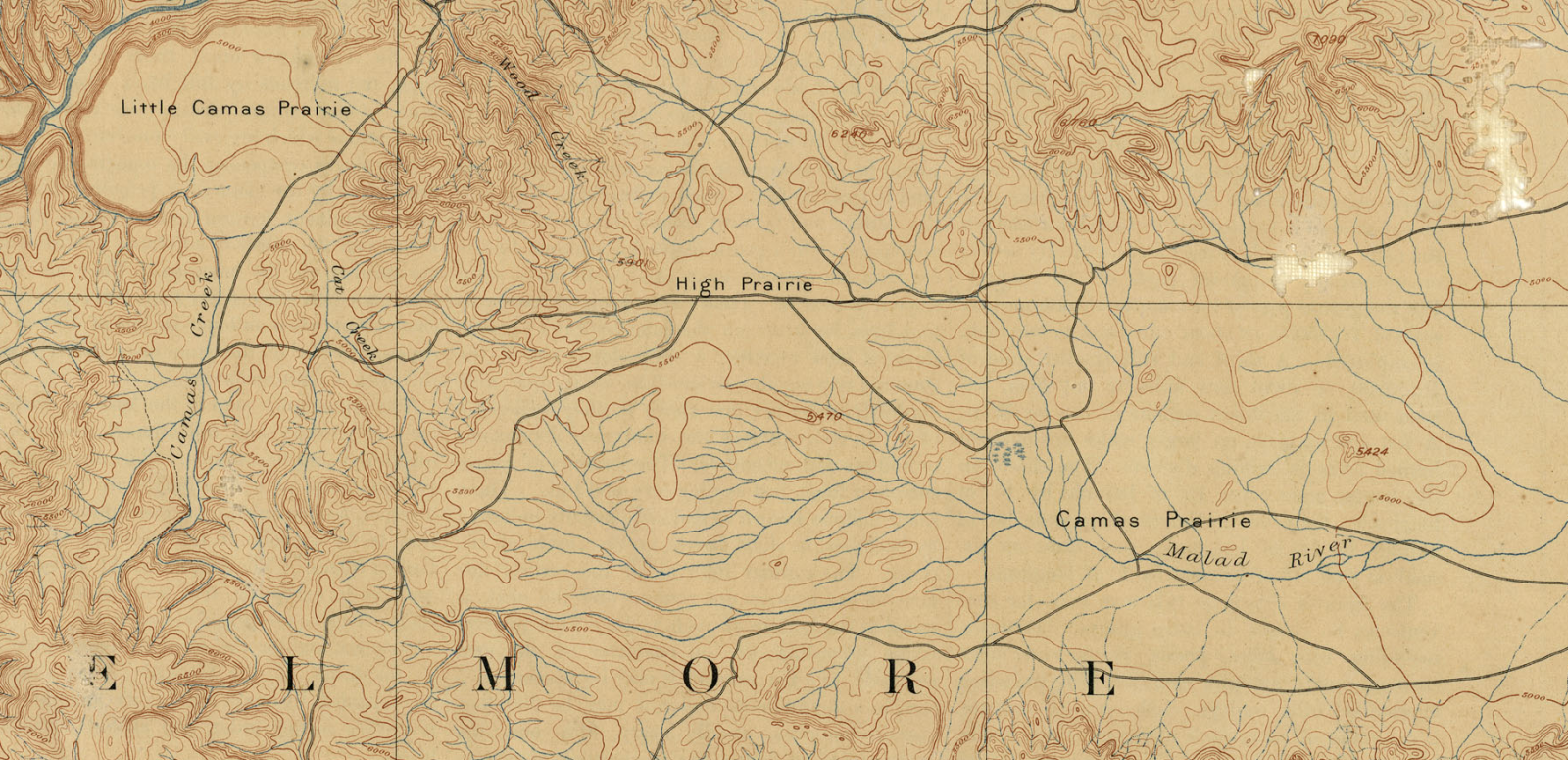
Map Collection, University of Texas, Austin. View the full map.

The headwaters of this Malad River are on the eastern slopes of Packer Butte, the western boundary of Camas Prairie. It becomes a braided marshland for a while, then reforms its channel prior to its entry into Camas Creek in eastern Elmore County, Idaho, ten miles east of its headwaters.[16] Camas Prairie, a lush wet prairie with hundreds of meandering rivulets, would have been a trapper’s dream come true. Peter Skene Ogden, John Work, and others traveled through the Camas Prairie in the 1820s. It is unclear who named this third Malad River, but apparently it, too, contained toxic beavers.
[1] Alexander Ross. The Fur Hunters of the Far West: A Narrative of Adventures in the Oregon and Rocky Mountains. Vol. I. London: Smith, Elder and Co., 1855, pp. 114–116. Read full text.
[2] Ross. The Fur Hunters of the Far West, pp. 114–116. Read full text.
[3] Peter Skene Ogden and T. C. Elliott. “The Peter Skene Ogden Journals.” The Quarterly of the Oregon Historical Society 10, no. 4 (1909): 331–365, at 355. JSTOR.
[4] William Fayel. A Narrative of Col. Robert Campbell’s Experiences in the Rocky Mountains Fur Trade from 1825 to 1835. Carol Kuhn, unpublished transcription of Fayel’s original 1886 notes, housed at the Missouri Historical Society, St. Louis, pp. 21-22
[5] This plant is also known as beaver poison, children’s bane, death-of-man, poison parsnip, and false parsley. Two separate species occur in Idaho. Cicuta bulbifera L. is found throughout Canada, south to the northern United States. Cicuta douglasii DC. (western water hemlock) is mainly limited to the Rocky Mountains. See Ray J. Davis et al. Flora of Idaho (Dubuque, Iowa: W. C. Brown, 1952).
[6] Personal communication, Carol Kuhn with Dr. Benedict Green, October 23–30, 2024.
[7] “Water Hemlock Poisoning—Maine, 1992.” Morbidity and Mortality Weekly Report, Centers for Disease Control and Prevention. Read article.
[8] Personal communication, Carol Kuhn with Mike Sandifer of Northwest School of Fly Fishing, Boise, Idaho, October 29–30, 2024.
[9] W. A. Ferris and Paul C. Philips. Life In The Rocky Mountains. The Old West Publishing Company. 1940. P 66-67. Read full text.
[10] Coordinates 42.945105, -114.795428.
[11] C. S. Walgamott. Reminiscences of Early Days. Vol. II. A Series of Historical Sketches and Happenings in the Early Days of Snake River Valley. 1927, pp. 41–42.
[12] Peter Skene Ogden. “Journal of Peter Skene Ogden; Snake Expedition, 1827–1828.” The Quarterly of the Oregon Historical Society 11, no. 4 (1910): 361–379, at 364. JSTOR.
[13] Coordinates 41.586195, -112.117299.
[14] Malad River headwaters in T14S, R35E, Sections 9 and 10. Its left bank tributary, Little Malad River, has its headwaters in T14S, R35E Section 3 [USGS Malad City West, Idaho]. Little Malad River joins the Malad southeast of Samaria, less than 10 miles south of Malad City. See USGS topographic map Brigham, Utah, T10N, R2W, Section 19, for mouth of Malad at Bear River and Bear River’s entry into Great Salt Lake.
[15] William Fayel. A Narrative of Col. Robert Campbell’s Experiences in the Rocky Mountains Fur Trade from 1825 to 1835. Carol Kuhn, unpublished transcription of Fayel’s original 1886 notes, housed at the Missouri Historical Society, St. Louis, p. 22.
[16] See Cat Creek Summit USGS Topographic Map, T1S, R10E, Section 33, for the headwaters of Malad River. Packer Butte is 38 miles NW of Gooding, Idaho.