
By Todd Glover
11/12/2026
Severe winters were one of the Mountain Men’s (Mountaineers’) greatest challenges to life and their pursuit of fortunes in the West. Examining extant mountaineer journals shows us how frequently the cold and snow were commented on.
Osborne Russell wrote, “Snow two or three feet deep and in many places drifts to the depth of 6 or 8 ft. deep.”[1] He also noted: “Here the snow was very deep over nearly the whole plain which was surrounded by high mountains.”[2]
Similarly, Warren Angus Ferris noted, “In all December the snow lay upwards of three feet deep, throughout Cache Valley; in other parts of the country the depth was still greater.”[3]
Another chronicler of mountain life, Zenas Leonard, also noted, “we found a plain about a mile wide, which with great difficulty, owing to the fierceness of the wind, we succeeded in crossing; but when we attempted to go into the timber, on the opposite side from the mountain, we found it impossible, in consequence of the depth of the snow …” [4]
Abundant snowfall and extremely frigid conditions effectively ended trapping in the northern Rockies during the winter months and forced mountaineers into winter camps in more sheltered valleys where wood, water, and forage for animals were available. Concerning winter camps, historian Dr. Kerry R. Oman notes,
Due to their small numbers and need for protection, American trappers wintered together throughout the 1820s. After spending the warm months operating out of temporary quarters, they generally arrived at the year’s chosen winter sites in November, though sometimes as early as October or as late as December and stayed until March. Abundant timber and game made the Great Salt Lake Valley and Willow Valley, today’s Cache Valley in southeastern Idaho and northern Utah, the chief wintering grounds for the mountain men until 1841, despite Mexican claims to this territory. Although Mexican officials had learned of these trespassers by the late 1820s, in reality little could be done to stop them.
As more trappers entered the trade in the early 1830s, competition and the depletion of beaver forced the mountain men into numerous smaller winter camps farther north, and many planned their fall hunts near locations where they could winter and still beat competitors to rich trapping grounds in the spring. Suitable sites, where the men had access to game, timber, and water, included the forks of the Snake River near today’s Rexburg, Idaho; the Snake River near the mouth of the Portneuf and Blackfoot rivers; the Salmon River near present-day Salmon, Idaho; the east fork of the Salmon River in today’s Lemhi Valley, Idaho; and the Little Salmon River Valley near present-day Pahsimeroi Valley, Idaho. Trappers also found conditions favorable near the confluence of the White and Green rivers; the Wind River Valley on the eastern side of the Wind River Mountains; and the Laramie River Valley. Brown’s Hole, the small section of land where the Green River flows through today’s northwestern Colorado, and the valleys of the Yellowstone River and its tributary, the Powder, were known as hospitable wintering locations as well.[5]
Snowshoes in the Historical Record
With deep snow being such an impediment to travel, trapping, and daily survival, one wonders to what extent the mountaineers made use of snowshoes to aid in traveling about during the winter months.
Surely nearly all of those numbered among the ranks of the Rocky Mountain beaver trappers were familiar with the use of snowshoes from their upbringing in the eastern United States and Canada. Many had grown up in regions where winter travel over deep snow was a routine necessity, and they would have understood both the construction and practical use of snowshoes long before venturing into the Rocky Mountains.
Additionally, the displaced Iroquois and Delaware trappers found in numbers among the mountaineers in the West would have been experts in the use and making of snowshoes from their life experience.
Conversely, it is interesting to note that none of the western tribes whose territory the mountaineers operated in had a strong tradition of using snowshoes.
However, the use of snowshoes by mountaineers is not completely absent from the historical record. The aforementioned trapper and journal keeper Warren Ferris, mentioned “the son of Mr. Montour, a young man of about nineteen, and myself employed ourselves in hunting deer on snow shoes; but in consequence of our not having files, our sport was quite limited.” [6]
There they are: primary-source references confirming what common sense and expediency would seem to have required under such conditions.
The Ogden Expedition: A Snowshoe Dilemma
Perhaps the most celebrated use of and role for snowshoes in mountaineer life is found in the contentious rivalry between American trappers and their Hudson’s Bay Company (HBC) counterparts, who sometimes contested the same trapping grounds.
Peter Skene Ogden led an HBC brigade of 28 trappers and some of their accompanying wives and families into the Snake River country of what is now southern Idaho in 1827–28. There they met and interacted with various American trappers, some working independently and others for the firm of Smith, Jackson, and Sublette.
Ogden was anxious to gain an advantage over the Americans and thus secure most of the available beaver pelts in the area. He bought pelts from the Americans and, in some cases, entertained the Americans in his encampment to distract them and allow his hunters to get afield first.
At one point, as the Americans’ supplies began to run short, they determined that they must travel south to the Great Salt Lake country, where they had cached provisions. However, the heavy snowfall made traveling by horse or on foot nearly impossible. The Americans observed that the Hudson’s Bay Company trappers possessed snowshoes and attempted to obtain some from them.
Ogden saw this as an opportunity to frustrate the Americans’ plans. He recorded in his journal, “The Americans are anxious to procure snow shoes, and I am equally so they should not as I am of the opinion they are anxious to bring over a party of trappers to this quarter. I have given orders to all not to make any for the Americans. This day they offered $25 for one pair $20.00 for another but failed. 5 men traded leather with the Snakes.”[7]
Several days later, he recorded,
The American is now very low spirited. He cannot hire a man to go to his cache nor snow shoes, nor does he suspect that I prevented. This day he offered 8 beaver and $50 for a pair and a prime horse to anyone who would carry a letter to the American camp. In this also he failed. I have supplied the American with meat as they cannot procure it without snow shoes. The Americans are starving on Bear River according to report, no buffalo in that quarter, they are reduced to eat horses and dogs. We could not learn from Indians if the American traders had come up from St. Louis.[8]
And two days later, he recorded this,
Snow and storms continue, a terrible winter. A man who went in quest of lost traps arrived with reports of fearful distress of the Americans. Horses dead, caches rifled. I believe this as a trapper saw calico among the Snakes, traded from the Snakes of the Plains. The Americans are determined to proceed but find it is to no purpose these extravagant offers. They are making snow-shoes themselves wh. they ought to have done 2 wks. ago. I cannot ascertain the motive of their journey south. I dread their returning with liquor. A small quantity would be most advantageous to them but the reverse to me.[9]
Now we see that the American trappers finally resorted to making their own snowshoes, prompting Ogden to wonder why they had not done so earlier, a question that also arises for modern readers looking back on the episode.
We now know that mountaineers did sometimes make and use snowshoes in the Rocky Mountains, although their use appears to have been relatively infrequent and perhaps underreported in the historical record. The surviving accounts suggest that snowshoes were employed when conditions demanded them, but they were not a routine part of the mountain trapper’s equipment.
What Kind of Snowshoes Did Mountaineers Use?
The question now remains: Which style of snowshoes did the trapper likely make?
The most common styles familiar to us today, and undoubtedly handed down through generations of winter travelers, include the following:
Beaver Tail/Michigan Style
- Long and narrow, with a pointed tail extending behind the foot.
- Common among many Algonquian-speaking peoples of eastern Canada and the Great Lakes.
- Excellent for packed trails and wooded country.
- Typically 4–6 feet long.
Huron/Alaskan Style
- Long, narrow, and often upturned at the toe.
- Designed for deep powder snow.
- Provides excellent flotation but can be cumbersome in thick timber.
- Variants were widely used across Canada and Alaska.
Bear Paw Style
- Shorter and broader, with a rounded or blunt tail.
- Maneuverable in dense forests and brush.
- Easier to use in broken timber than long snowshoes.
- Common in many northern forest regions.
Ojibway Style
- Long, with a sharply pointed toe and tail.
- Often considered among the most efficient designs for very deep, soft snow.
- The elongated shape distributed weight exceptionally well.
- Common around the Great Lakes and western Canadian forests.
Making Snowshoes in the Mountains
Of these principal styles, it is this author’s opinion that the Ojibway-style snowshoe was the type most likely employed by a mountaineer when the need arose. The primary reason is its relative simplicity of construction. Unlike many other forms of snowshoes, the Ojibway style requires very little bending of the frame and does not depend upon steaming the wood to make it pliable. A serviceable pair could be fashioned from two appropriately sized saplings or branches lashed together at both ends and spread apart with two or three crosspieces. Once the frame was completed, webbing made from rawhide strips cut from a large game animal, such as a deer, elk, or moose, could be stretched and laced across the frame. As the rawhide dried, it would tighten, producing a durable and functional snowshoe that could be constructed with minimal tools and materials readily available to the mountaineer in the field.
A foot harness could also be fashioned easily from dressed leather or fiber rope.
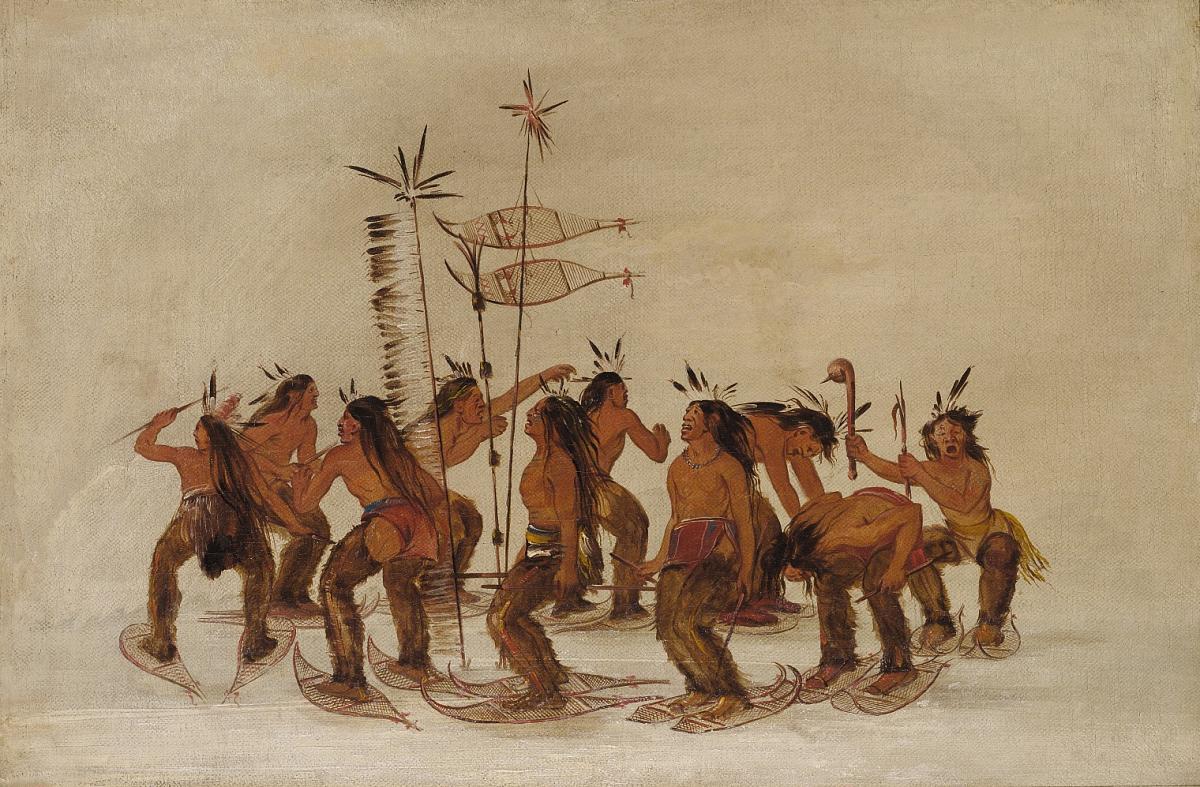
George Catlin, Snowshoe Dance at the First Snowfall, 1835-1837, oil on canvas, 19 1/2 x 26 7/8 in. (49.5 x 68.2 cm).
Image Courtesy of Smithsonian American Art Museum, Gift of Mrs. Joseph Harrison, Jr., 1985.66.451.
Beside ease of manufacture, the Iroquois and Delaware trappers among the mountaineers likely used this style of snowshoe, as it was prevalent where they originated in the Great Lakes region. They could fashion such snowshoes quickly and teach other mountaineers to make them as well.
No mention is made of mountaineers carrying snowshoes with them throughout the year. Consequently, if they did construct snowshoes for winter travel, they were likely made with an economy of effort in mind and intended as temporary tools rather than permanent equipment. Once conditions improved or travel no longer required them, such snowshoes may well have been discarded. This would help explain the scarcity of references to snowshoes in the historical record, as a mountaineer could quickly fashion a serviceable pair from locally available materials when needed rather than transport them over long distances during seasons when they served little purpose.
The following image illustrates the simplicity of the Ojibway-style snowshoe. Although these snowshoes were made in Alaska, they show the same basic design characteristic of Ojibway snowshoes.
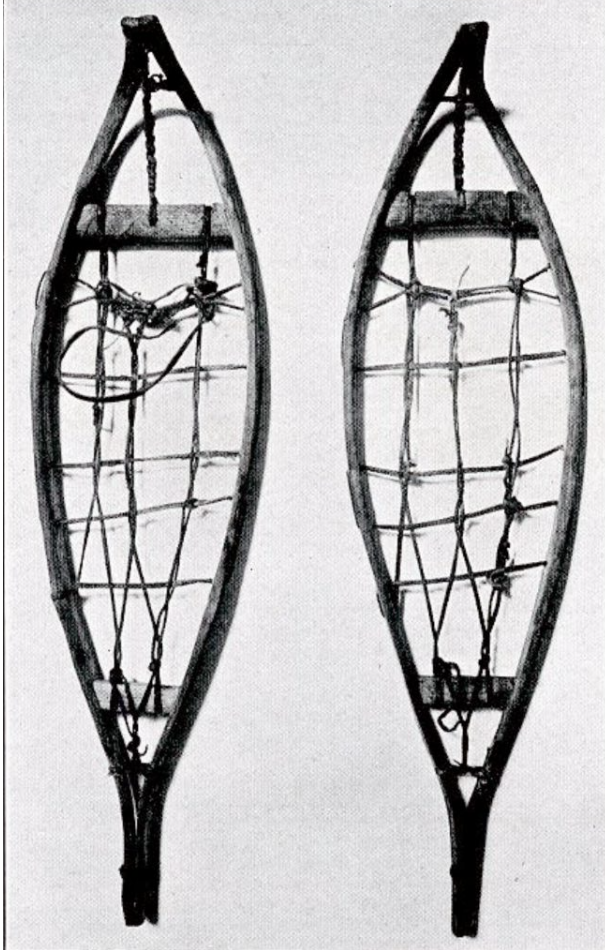
University of Pennsylvania Museum, December 1911, p. 86. Read full article here.
A Practical Tool for Winter Survival
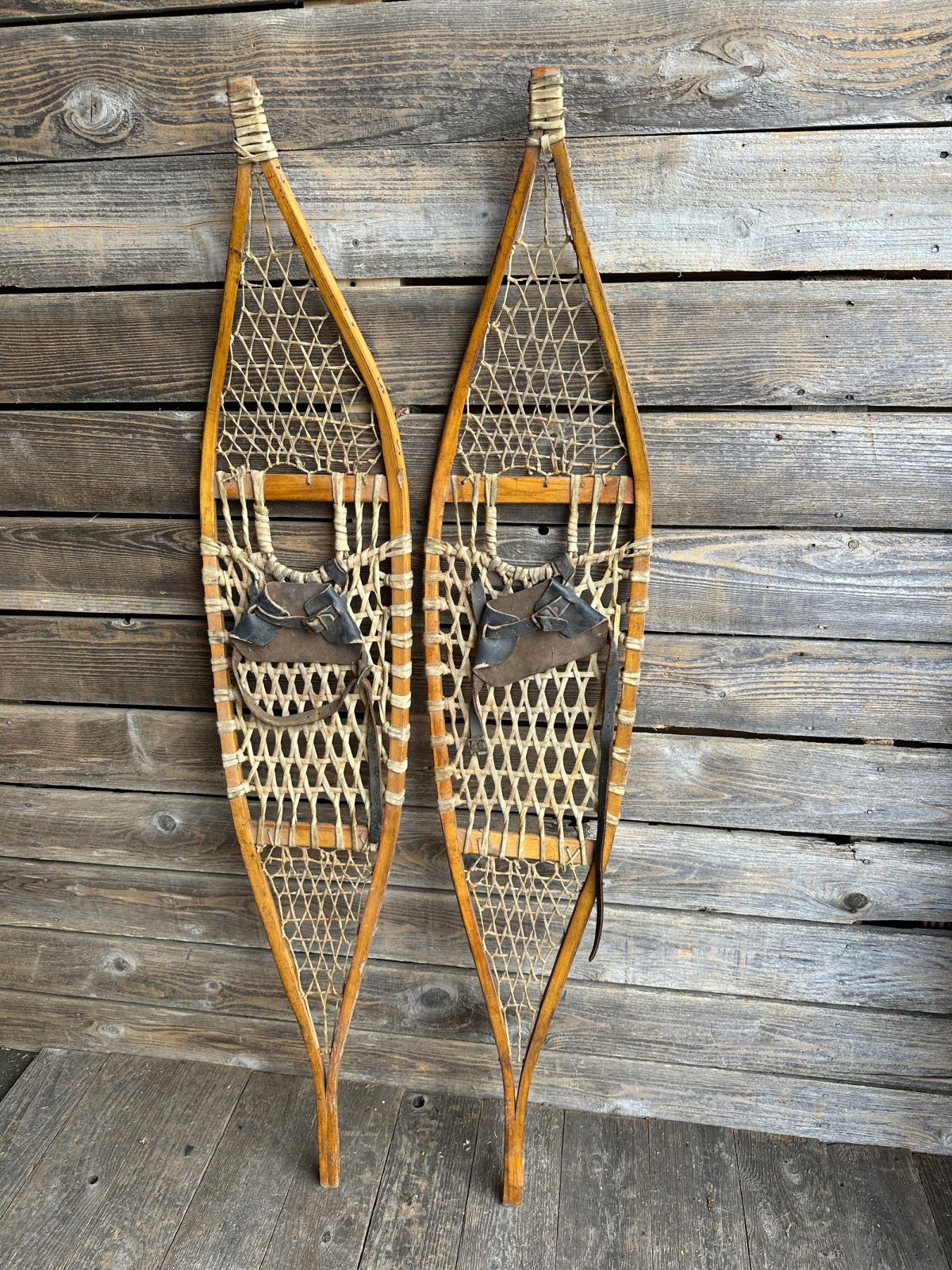
The use of snowshoes among the beaver hunters of the Rocky Mountains does not appear to have been especially common, and references to their use among the native peoples of the region are likewise relatively scarce in the historical record. Nevertheless, enough accounts survive to demonstrate that snowshoes were not altogether unknown to the trappers. Given their prior experience in the forests of the East and Canada, the ready availability of suitable materials, and the ingenuity for which mountaineers were renowned, it is not surprising that some trappers made and used snowshoes when conditions required them. What is perhaps more surprising is that a greater number did not employ them, considering the deep snows and severe winter conditions they so often endured in the Rocky Mountains.
Endnotes
[1] Osborne Russell, Journal of a Trapper, ed. Aubrey L. Haines (Lincoln: University of Nebraska Press, 1955), 10. Read full text.
[2] Russell, Journal of a Trapper, 13. Read full text.
[3] Warren Angus Ferris, Life in the Rocky Mountains: A Diary of Wanderings on the Sources of the Rivers Missouri, Columbia, and Colorado, 1830–1835, ed. Paul C. Phillips (Denver: Old West Publishing Company, 1940), 69. Read full text.
[4] Zenas Leonard, Adventures of a Mountain Man: The Narrative of Zenas Leonard, ed. Milo Milton Quaife (Lincoln: University of Nebraska Press, 1978), 25. Read full text.
[5] Kerry A. Oman, “Winter Camps of the Mountain Men,” Montana: The Magazine of Western History 52, no. 1 (Spring 2002): 34–47.
[6] Ferris, Life in the Rocky Mountains, 311. Read full text.
[7] Peter Skene Ogden, Journal of Peter Skene Ogden: Snake Expedition, 1827–1828, Oregon Historical Quarterly 11 (1910): 369. Read full text.
[8] Ogden, Journal of Peter Skene Ogden, 370-371. Read full text.
[9] Ogden, Journal of Peter Skene Ogden, 371. Read full text.
Enjoyed This Article?
Stay connected with the Museum of the Mountain Man for more historical articles, museum news, upcoming events, and exhibit highlights.
Join Our Mailing List