
By Tim Tanner
September 29, 2026
What would an artist carry into the Rocky Mountains if the nearest art store was not across town, but somewhere back east beyond weeks—or months—of travel? It is easy for modern artists to imagine a supply problem in terms of inconvenience: a missing tube of burnt sienna, a worn-out brush, a sketchbook left at home. For an artist visiting a western fort or attending an 1825-40 Rocky Mountain rendezvous, however, the problem was far beyond inconveniences. Often it was survival of the materials themselves. Every pencil, every sheet of paper, every color, and every brush had to be planned for, brought along, protected, and made to count.
As a professional artist and historian, I have vague memories of sitting in my college Art History courses learning about the logistics of painting during, say, the Renaissance era. Artists at that time were far more “hands-on” regarding their materials. In fact, they almost fit into the same guilds as pharmacologists, using a mortar and pestle as naturally as a modern painter uses a palette knife. For example, an artist might grind cinnabar, the mineral source of vermilion, and combine the resulting pigment with a binding medium such as linseed oil to create a brilliant red or scarlet hue.[1] The process was not merely artistic; it was part chemistry, part craft, part hard labor, and occasionally part poisoning oneself with mercury. Art has always had its little inconveniences.
From the Renaissance to the Rocky Mountains
As I’ve studied artists of the fur trade frontier over the years, I found myself wondering if those historical artists were limited to similar methods and procedures. If an artist found himself at a western fort, or even at a rendezvous in the mountains, did he need to grind pigments and manufacture paint from raw materials? Did he arrive with little jars, powders, oils, and a frontier-sized chemistry set? One obvious clue comes from Alfred Jacob Miller, the only artist known to have attended one of the original Rocky Mountain rendezvous. During his 1837 journey, Miller appears to have relied heavily on pencil and watercolor studies in the field, later developing many of those observations into more finished oil paintings in the studio.[2] But was that simply Miller’s personal preference? After all, George Catlin was well known for painting full-fledged oil portraits on canvas during his travels among Native peoples. So the question remains: what was actually available to an artist in this period, and what would have been practical to carry?
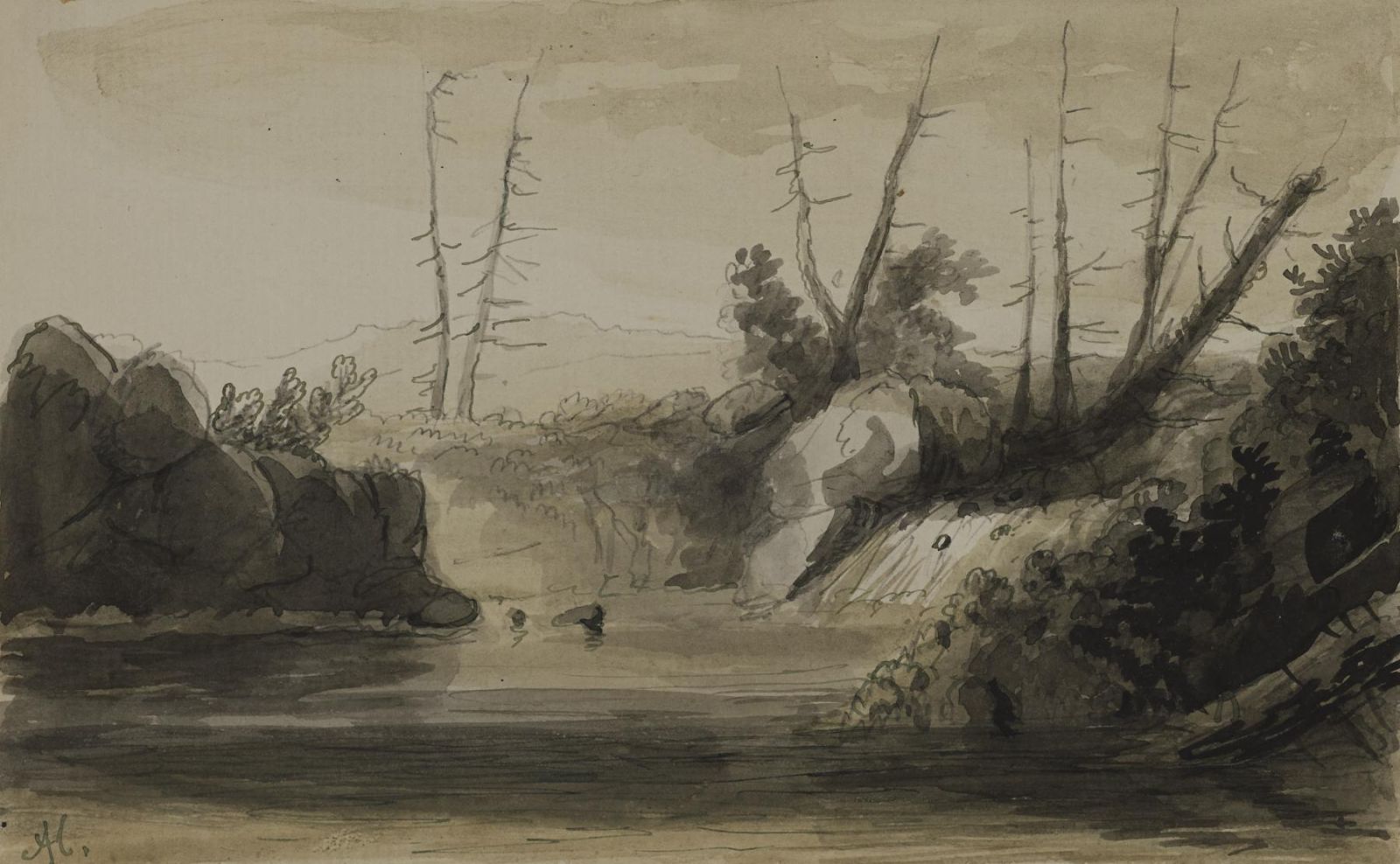
With those thoughts in mind, let me share what I found.
Art Supplies Were Available – But Not in the Mountains
During the early years of the nineteenth century, art supply availability had advanced significantly from the Renaissance years. Artists were no longer universally required to begin with raw mineral or organic materials and manufacture every color by hand. In America’s larger cities, many supplies could be purchased through stationers, booksellers, imported-goods merchants, and artists’ color dealers, who stocked pigments, papers, brushes, pencils, and other necessities. Across the Atlantic, specialized firms such as Charles Roberson & Co. (founded in 1820) and Winsor & Newton (founded in 1832) illustrate how the commercial art supply industry was rapidly evolving during this same period.[3] Likewise, an 1828–1830 catalogue published by the English firm Reeves & Sons advertised portable paint boxes, prepared colors, papers, pencils, and other artists’ materials.[4]
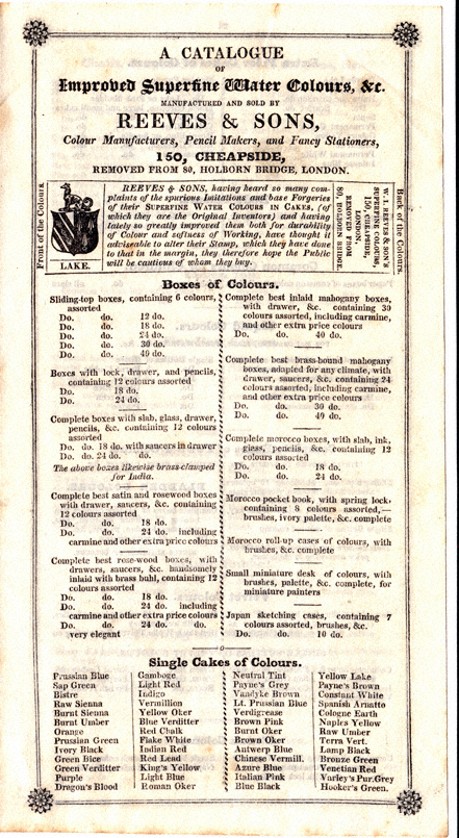
Photograph courtesy of Ronald M. Bodoh. Image courtesy of www.whimsie.com.
Although these examples come from England, they demonstrate that by the time Alfred Jacob Miller traveled west in 1837, commercially prepared art supplies were no longer a novelty. An American artist could reasonably expect to purchase similar materials before leaving the settled East, even if replacing them on the frontier was another matter altogether.
There is a big difference between “available in Baltimore” vs. “available in the Wind River country.”
This does not mean that a frontier artist could stroll into Fort William or a Green River rendezvous and ask where they kept the French ultramarine. There is a big difference between “available in Baltimore” vs “available in the Wind River country.” The important point is that an artist leaving from a major city—or perhaps outfitting in St. Louis—could have purchased prepared materials before departure. A compact watercolor box, pencils, ink, brushes, and good paper were not imaginary luxuries. They were commercially available goods. Once the artist left the supply centers, however, replacement became the problem. A broken brush or spoiled paper was not easily remedied. The frontier did not forgive poor packing.
Before the Paint Tube
When artists returned to their studios, they were not yet at a stage where they could simply go down to the art supply store and purchase modern tubes of oil paint. The collapsible metal paint tube was patented by John Goffe Rand in 1841, just after the 1825–1840 period under consideration.[5] Even then, such an invention would not have become instantly and universally available, especially to an artist heading west. Before the paint tube, oil colors could be prepared and transported, but they were commonly stored in less convenient ways—such as small pots, bladders, or other containers that were more fragile, messy, and prone to drying out. This helps explain why watercolor was such a practical field medium. It was compact, relatively durable, and could be reactivated with water. Pencil and watercolor allowed the traveling artist to gather visual information quickly without hauling a full studio across the plains.
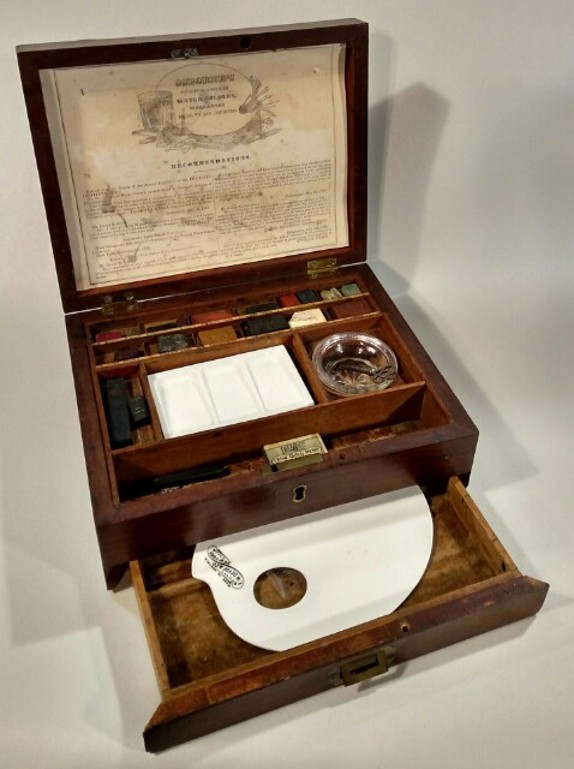
Photograph courtesy of Ronald M. Bodoh. Image courtesy of www.whimsie.com.
A Transitional Art
This distinction is important. The frontier artist of the 1830s was not exactly like a Renaissance painter grinding every color from scratch, but neither was he a modern plein-air painter with a tidy box of aluminum paint tubes. He lived in a transitional world. Commercial art supplies existed, but they had to be selected carefully, packed intelligently, and guarded from weather, breakage, and distance. A practical artist attending a rendezvous or visiting a western fort would most likely have worked first as an observer: sketching figures, clothing, horses, lodges, landscapes, weapons, and moments of daily life in pencil and watercolor. Larger oil paintings, if they were made at all, were more likely to be completed later, when the artist was again in a studio with space, time, and supplies.
In that sense, every surviving sketch from the period represents more than artistic talent. It represents planning. It tells us that somewhere before the mountains, an artist made deliberate choices: which papers to bring, which colors to trust, which brushes were worth the risk, and how much weight he could justify carrying. At rendezvous, art was not only a matter of seeing well. It was a matter of having remembered to pack the means of seeing.
End notes:
[1] The Metropolitan Museum of Art distinguishes cinnabar as the mineral and vermilion as the pigment, noting vermilion’s long-standing importance as a brilliant red pigment. (https://www.metmuseum.org/perspectives/cinnabar-vermilion)
[2] Alfred Jacob Miller is the key case study for the 1837 Rocky Mountain rendezvous; his field practice is commonly described in terms of pencil and watercolor studies later developed into finished works.
[3] The Fitzwilliam Museum identifies Charles Roberson & Co. as founded in 1820 and Winsor & Newton in 1832, both major nineteenth-century artists’ material suppliers. (https://fitzmuseum.cam.ac.uk/research/projects/the-colourman-archives-of-roberson-co-and-winsor-newton-a-history-of-colour)
[4] The Reeves & Sons catalogue from around 1828–1830 lists colors, boxes, papers, pencils, and related materials. (https://www.whimsie.com/reeves%20sons%20c.1830%20art%20materials%20catalogue.html)
[5] The Archives of American Art identifies John Goffe Rand’s 1841 patent drawings for his collapsible metal tube for paint. (https://www.aaa.si.edu/collections/items/detail/john-goffe-rand-patent-improvement-construction-vessels-or-apparatus-preserving-paint–c-460)
Enjoyed This Article?
Stay connected with the Museum of the Mountain Man for more historical articles, museum news, upcoming events, and exhibit highlights.
Join Our Mailing List