
By Vic Nathan Barkin
June 12, 2026
On April 24, 1831, a company of seventy men under John Gantt and Jefferson Blackwell left St. Louis on a trapping and trading venture bound for the Rocky Mountains. Twenty-two year-old Zenas Leonard was hired on as a clerk, trapper and trader, and kept a detailed record of the expedition.
According to Leonard, the brigade left St. Louis, going up the Missouri River to the mouth of the Kansas River, which they ascended. Following the Republican Fork, they then crossed overland to the Platte River, travelling up to its confluence. Heading up the North Platte, they reached the mouth of the Laramie River on August 27, 1831. While encamped there, they encountered Thomas Fitzpatrick with a small party of Rocky Mountain Fur Company men heading to St. Louis.
Fitzpatrick, viewing Gantt and Blackwell as interlopers, was most unhelpful during their meeting, but he agreed to allow Captain Blackwell with a couple of men to accompany him back to St. Louis to obtain more supplies for the following summer.
Gantt then divided his men into three companies, to better exploit the fur resources of the area. One party under Captain Gantt himself went up the Sweetwater. A second party worked the Timber Fork under Captain Washburn, and a third party under Captain A.K. Stevens, of which Leonard was a member, ascended the Laramie River.
The three parties separated on September 4th 1831 “after shaking hands all round” and 21 men, including Leonard under Stevens continued upriver until September 20th when they stopped on the bank of a small creek to rest. At this junction, signs of beaver were seen, and two men were sent out to explore and trap.
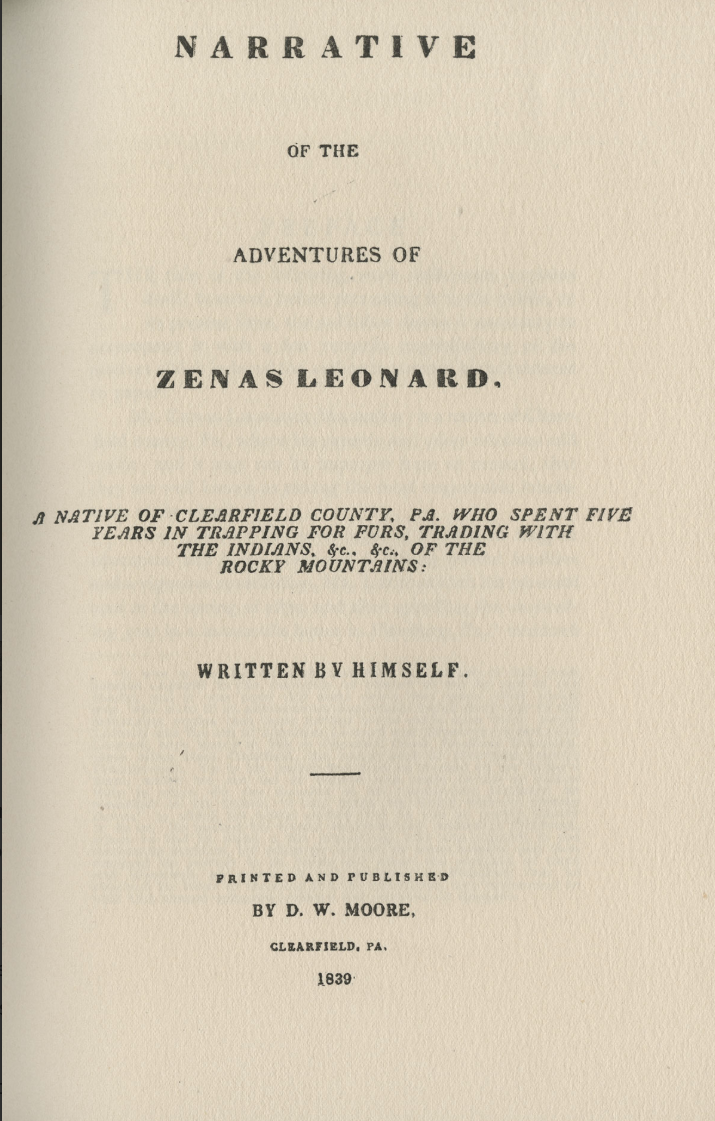
They had meandered the creek till they came to beaver dams, where they set their traps and turned their horses out to pasture; and were busily engaged in constructing a camp to pass the night in, when they discovered, at a short distance off, a tremendous large Grizzly Bear, rushing upon them at a furious rate.- They immediately sprang to their rifles which were standing against a tree hard-by, one of which was single and the other double triggered; unfortunately in the hurry, the one that was accustomed to the single trigger, caught up the double triggered gun, and when the bear came upon him, not having set the trigger, he could not get his gun off; and the animal approaching within a few feet of him, he was obliged to commence beating it over the head with his gun. Bruin, thinking this rather rough usage, turned his attention to the man with the single triggered gun, who, in trying to set the trigger (supposing he had the double triggered gun) had fired it off, and was also obliged to fall to beating the ferocious animal with his gun; finally, it left them without doing much injury, except tearing the sleeve off one of their coats and biting him through the hand. (Full text)
These two trappers had rifles similar enough to be mistaken for one another, at least in that panic situation.
For those unfamiliar with a “double trigger” (aka: double set trigger) rifle, the rear trigger “sets” the front trigger turning it into a “hair” trigger. Neither the rear or front trigger fires the gun by its self, but once the rear trigger is “set”, the front trigger releases the rear which is held under spring pressure, thus hitting the lock’s sear, firing the rifle. There are other assemblies which do in fact allow firing using the front trigger without setting the rear trigger first, but this was obviously not the case with the rifle in this story.
A “single triggered” rifle is just that. When the trigger is depressed it releases the sear nose from the tumbler’s full-cock notch, allowing the cock (referred to today as the hammer) to fall.
A third variation referenced in the AFC orders, although not mentioned in Leonard’s tale, is called a “double-phase/single-set trigger”. This is similar in operation to a “double set trigger” except that the single trigger is pushed forward to “set” it to a hair trigger. The rifle can be adjusted to be fired either set or unset.
“Double-set” and “single-set” triggers require a “fly” in the lock’s tumbler to prevent the sear nose from catching on the half-cock notch, and use a “set screw” in the trigger plate to adjust the “hair trigger”. Single triggers do not need either a fly or a set screw.
Regarding Leonard’s journal, how and why would two similar rifles have two different trigger configurations? The American Fur Company (AFC) was already the big dog as far as purchasing power was concerned, having direct relationships with manufacturers on the east coast and overseas. Their competition did not.
A clue leading to how two trappers might have wound up with nearly identical rifles but with different trigger configurations was in a purchase order from the AFC to four Lancaster, Pennsylvania gunsmiths under a single contract in early 1831. It is excerpted here:
Christopher Gumph
24 to 30 Rifles Single Trigger @ $11.00
10 of the above Rifles are to have a set trigger and fly in the lock @ $11.25
Henry Gibbs
24-30 Rifles same as above @ $11.00
John Dreppard
24 to 30 Rifles same in all respects as those to be furnished by Henry Gibbs.
Jacob Fordney
10 Rifles double triggers @ $12.00
2 Rifles single triggers same as those above at $11
An associated “Invoice” identifying the actual quantities, prices and date shipped specifies that the order was sent to the “American Fur Company St Louis”. In it is detailed:
10 (C Gumpf)	Rifles _ Fly & set screw single trigger	$11.25
20 (C Gumpf)	   “    _  Plain single trigger			$11.00
24 (H Gibbs)	   “    _  Plain single trigger			$11.00
24 (J Dreppard) “   _  Plain single trigger			$11.00
10 (J Fordney)	   Double trigger			$12.00
2 (J Fordney)	   “    	      Single      “			$11.00
______________________________________________
90 Rifles			New York 25th February 1831
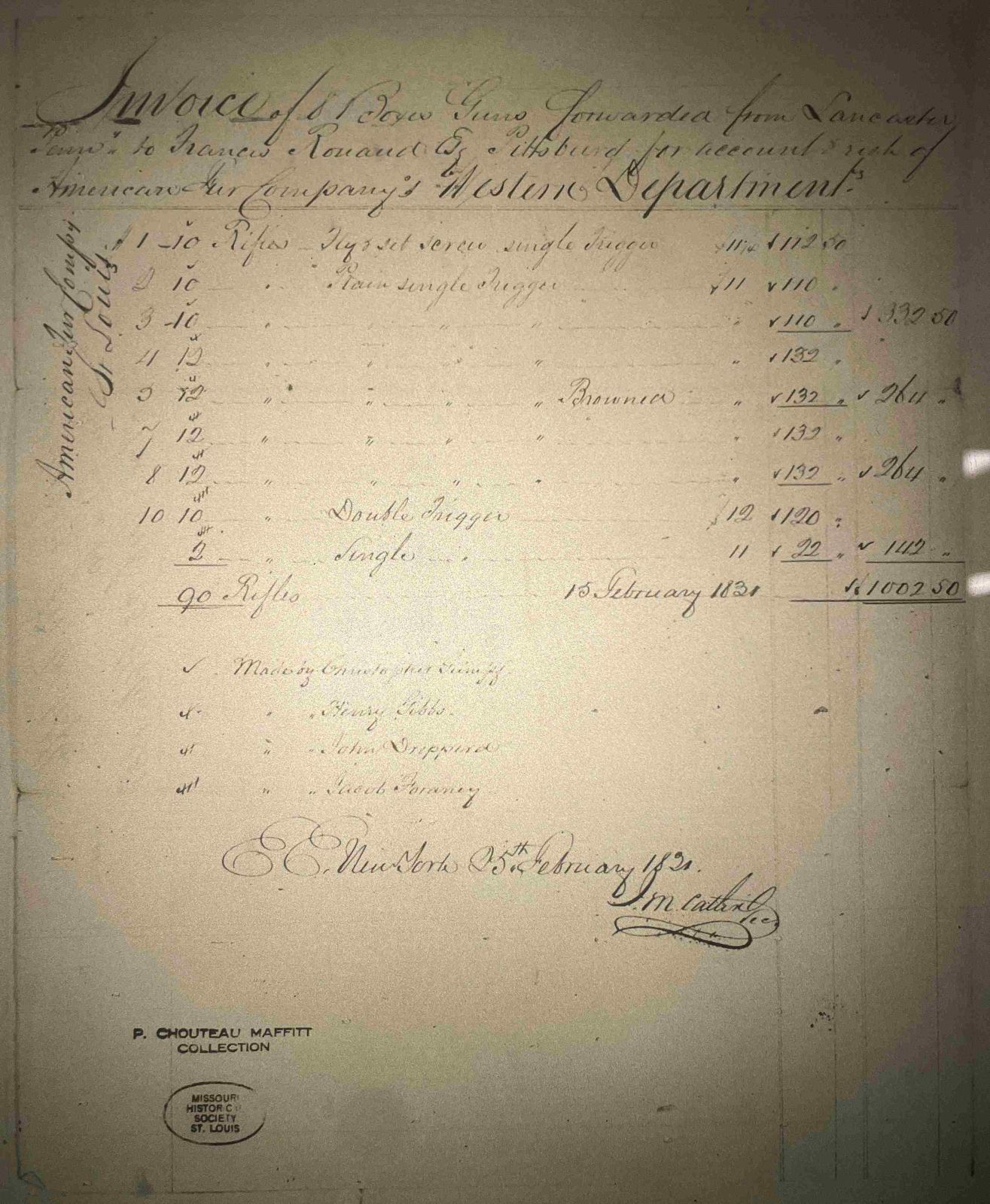
Jacob Fordney’s 10 “double trigger” rifles along with 40 single trigger rifles by Dreppard, Gibbs and Fordney were shipped to St Louis on February 25, 1831. We don’t know when they shipped from St. Louis. We do know the Christopher Gumpf rifles (20 single trigger and 10 single set trigger) were shipped from St. Louis to the “Upper Missouri Outfit” (UMO) on May 21, 1831.
What can we ascertain out of all of this? Leonard stated, “Each man was furnished with the necessary equipments (sic) for the expedition — such as traps, guns, &c.; also horses and goods of various descriptions, to trade with the Indians for furs and Buffaloe robes.”
It is evident from Leonard that these two trappers had very similar rifles, if not by made the same gunsmith, possibly from the same group of gunsmiths. There is no objective evidence pointing to Gantt and Blackwell purchasing directly from the American Fur Company in 1831. It was, however, a general practice of the AFC to subvert their rivals such as the Rocky Mountain Fur Company financially through any means possible including selling supplies to their rival’s competitors which included Gantt and Blackwell.
Was it just a fluke that Zenas Leonard’s two trapper buddies happened to have identical or at least similar rifles with different trigger configurations at the very same time the AFC was known to have been intentionally ordering the same? Something deep down says no. For now though, this whole scenario remains an intriguing mystery, with too many coincidences not to be connected.
Bibliography
- Kaufman, Henry J. The Pennsylvania-Kentucky Rifle. New York, NY: Bonanza Books, 1960.
- Leonard, Zenas. Narrative of the Adventures of Zenas Leonard. Edited by Milo Milton Quaife. Chicago, IL: The Lakeside Press, 1934.
- Gowans, Fred R. Rocky Mountain Rendezvous. Layton, UT: Peregrine Smith Books, 1985.
- Hafen, Leroy R. Broken Hand, The Life of Thomas Fitzpatrick, Mountain Man, Guide and Indian Agent. Denver, CO: The Old West Publishing Company, 1973
- Swagerty, William R, ed. Papers of the St. Louis Fur Trade, Part 3: Robert Campbell Family Collection from the St. Louis Mercantile Library Association; Reel 17. St. Louis MO: Missouri Historical Society and the St. Louis Mercantile Library Association. Available here.