By Scott Walker
August 28, 2026
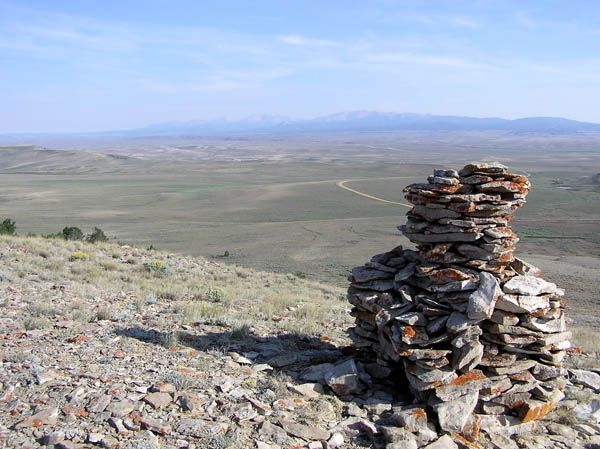
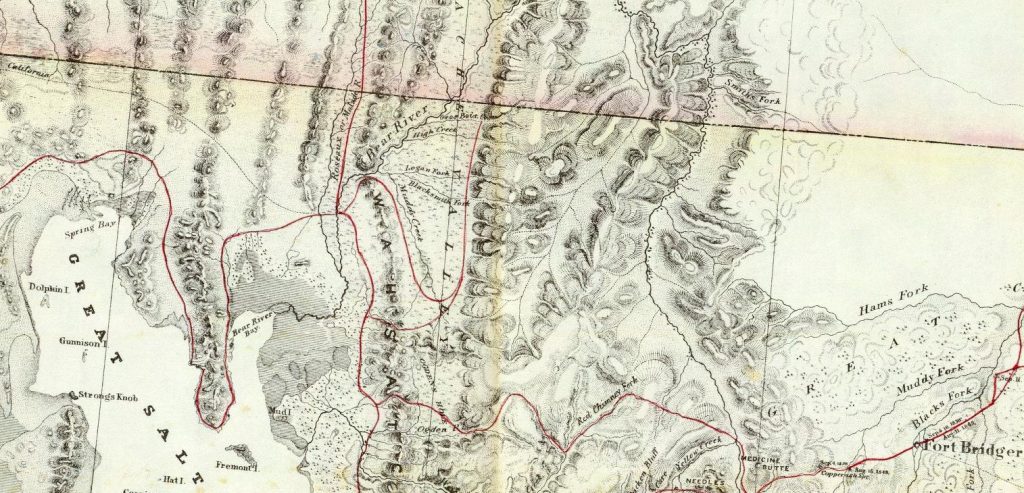
During the journey to the original Bear Lake Rendezvous of 1827 and back, William H. Ashley, fur trader, politician, and militia general, achieved a first. He took a wheeled vehicle through South Pass, proving Robert Stuart’s 1813 assessment correct: this pass across the Continental Divide was gentle enough for wagons.
Ashley wrote:
In the month of March, 1827, I fitted out a party of 60 men, mounted a piece of artillery (a four pounder) on a carriage which was drawn by two mules; the party marched to or near the Grand Salt lake beyond the Rocky mountains, remained there one month, stopped on the way back fifteen days, and returned to Lexington, in the western part of Missouri, …
Thousands of wagons would travel through what would become known as South Pass, hauling freight and emigrants, but the very first wheeled vehicle to cross was a cannon. It provided Ashley and his brigade an added bang of celebration at rendezvous, a way to impress Native Americans with the noise, and a formidable defense if the party feared attack. Ashley may also have wanted to know if wheels could survive a round trip to the mountains, with future wagonloads of trade goods in mind.
What Was Ashley’s Four Pounder
Ashley’s description inspires more speculation than surety about this first vehicle to cross the Continental Divide: there is not enough information to pin down the exact description of this groundbreaking gun and its carriage. However, from Ashley’s few words, we know the size of the cannon’s ammunition, and can get a sense of its weight.
The term “four pounder” (Ashley’s unhyphenated form of “four pounder” will be used) did not refer to the weight of the artillery piece itself, but to the weight of a solid iron ball that would just fit down the bore of the particular cannon tube. Artillery manuals of the time commonly referred to three, four, six, twelve and twenty-four pounders, all indicating the size of the bore by stating the weight of the round ball it fired. It is a similar concept to how the gauge of modern shotgun barrels is described. A four pounder had a bore diameter of about 3 1/3 inches.
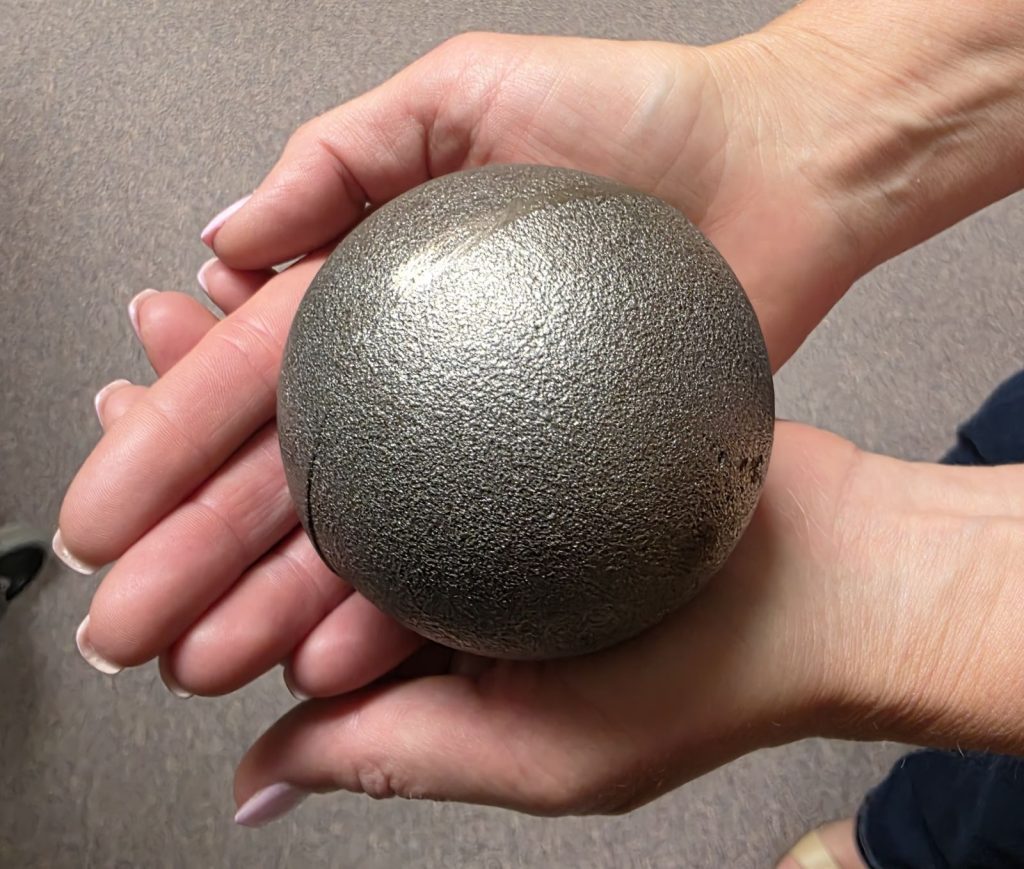
How the Cannon Worked
In 1827, breechloading artillery, which could be loaded from the back of the barrel, was still rudimentary and uncommon. This meant that Ashley’s four pounder was a muzzleloader: it needed to have the powder and projectile loaded through the front of the barrel with a rammer. It was also single shot, and had to be reloaded each time it was fired.
Weight, Design, and Mobility
Cannon barrels, called tubes, were cast of various metals, and had to strike a balance between being thick enough to withstand the stress of firing the gun, while being light enough to suit the purpose of the cannon. Shipboard cannon and those meant for stationary fortifications could have heavier barrels than cannon designed to be maneuvered around a battlefield. A heavier barrel could withstand a bigger powder charge and throw a projectile farther, but this was at the expense of increased weight and reduced mobility. Ashley stated that his artillery piece, mounted on a carriage, could be pulled by two mules. This probably rules out repurposed shipboard or fortress cannon, and indicates a lighter field piece.
Four pounder field guns used by armies during the Napoleonic Wars (1792-1815) were designed to be mobile enough to keep up with and support infantry units. Each cannon was mounted on a wooden, two-wheeled carriage, and its ammunition was carried on a two-wheeled cart, called a limber. When a four pounder was moved, the gun carriage and limber were hitched together and hauled by three or four horses. Two mules could not have drawn a standard gun carriage and limber very far. Ashley, a military man, would have known what a limber was, and he did not mention using one. This suggests the cannon was mounted on its carriage and the ammunition was carried in mule packs, rather than on a limber.
The Mystery of the Gun Carriage
Ashley left us no details of the carriage or its design. Was it standard military, or the creation of a St. Louis wagon maker, built with the rugged trail to rendezvous in mind? Artillery manuals of the day commonly included detailed drawings and specifications of gun carriages so a local craftsman would have a reference to work from. Whatever the design, it had to balance strength and light weight for two mules to pull it from Missouri to what is now northern Utah, and back.
The Cannon at Rendezvous
Arriving at the 1827 Rendezvous after his expedition to California, Jedediah Smith recorded:
My arrival caused a considerable bustle in camp, for myself and party had been given up as lost. A small Cannon brought up from St. Louis was loaded and fired for a salute.
Smith’s use of the word, “small,” is descriptive, but, like Ashley’s words, not definitive. Smith would have seen field pieces during the Arikara War (US six pounders, and a twelve pounder howitzer), and perhaps Mexican artillery in California, along with defensive shipboard cannon on coastal trading ships. “Small” compared to what?
The size of the bore, the lack of a limber, and a total weight limited by the available two-mule power is the extent of what can be known from Ashley’s brief description.
Four Pounders in Military History
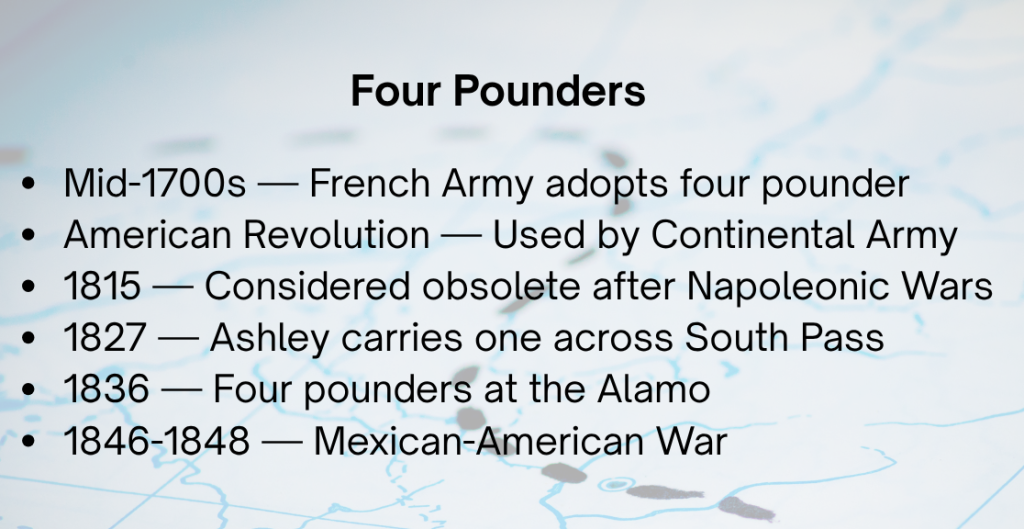
For comparison, the French Army of the mid-18th century began using a scaled-down four pounder based on a Swedish design. Considered light for the time, the tube weighed approximately 700 pounds and was just under five feet long. It was meant to be moved quickly around a battlefield to give artillery support to infantry formations as a battle evolved. The common ammunition was solid, four-pound round shot, which bowled through enemy formations, and cannister shot which scatter-gunned the enemy with thumb-sized balls. The French used these guns for over half a century.
During the American Revolution, the French sent four pounders as military aid to the Continental Army. At Spanish St. Louis, in 1780, the militia used four pounders to help repel an attack by a British and Indian force during the farthest-west battle of the Revolutionary War.
By the end of the Napoleonic Wars (1815), four pounders, as a size, were considered obsolete: the French, British and American armies had determined that a six pounder was still light enough to be mobile, while packing a greater punch than the four pounder. This did not mean four pounders were scrapped. An out-of-date four pounder barrel, if it was sound, could still be an effective weapon, either used in the original configuration, or, if the tube’s metal was thick enough, rebored to the larger six-pound size. New wooden carriages could be built as needed. There were four pounders at the Alamo in 1836, and the Mexican Army was still using four pounders in the Mexican-American War of 1846-48.
Questions That Remain
Could Ashley have used his militia rank of general to pull some strings and get an old gun out of arsenal storage? Could the fact that four pounders were obsolete in 1827 have made a gun tube of this size available for an experiment that might end with the gun abandoned in the mountains? Was the cannon a civilian, non-military design purchased for the trip? Was the carriage built specially for hundreds of miles of prairie travel, or did Ashley make do with a standard Army gun carriage? At this point these are unanswered questions and intriguing speculations. The answers to these questions might be in period Missouri Militia records, in an inventory from the Belle Fontaine Arsenal, or the Saint Louis Arsenal that replaced Belle Fontaine in 1827. The information has yet to surface.
Whatever it looked like, fur trader William H. Ashley could claim this historic first. Tens of thousands of emigrants, pioneers, freighters, and their wagons and carts, were proceeded by two mules and a cannon. To paraphrase Bishop George Berkeley, Westward the course of a four pounder took its way.
Watch: Firing a Replica Four-Pounder
To see a four-pounder field piece in action, watch this short demonstration video below.
Further Reading
Historic artillery is a study in itself, and far beyond the scope of this article. A good place to start is with Round Shot and Rammers, by Harold L. Peterson.
For information on how artillery was being used by armies in Europe, read, Artillery of the Napoleonic Wars: A Concise Dictionary 1792–1815, by Kevin F. Kiley.
Period artillery manuals are available online. For the US Army at the time of the War of 1812, a favored manual was American Artillerist’s Companion or Elements of Artillery …,by Louis de Tousard. The full text is available for free at the Hathi Trust website.
For samples of illustrative plates from American Artillerist’s Companion or Elements of Artillery …, see this collection of images.
William Ashley’s description of his journey with the four pounder is excerpted from a letter from Ashley to General Alexander Macomb. The full text can be read in United States Senate Executive Document 39, 21st Congress, 2nd Session, 1831, pp 1-7, available here.
Jedediah Smith’s quote comes from his journal of his first expedition to California, entry for July 3, 1827, which can be seen here.
Related Publication
Interested in learning more about the use of wheeled vehicles in the Rocky Mountain fur trade? Rocky Mountain Fur Trade Journal, Volume 4, includes E. Rick Williams’s “Wheels to Rendezvous,” an exploration of how wagons and fur trade supply routes helped open the way for westward migration. The journal is available in the Museum of the Mountain Man Trading Post.
Enjoyed This Article?
Stay connected with the Museum of the Mountain Man for more historical articles, museum news, upcoming events, and exhibit highlights.
Join Our Mailing List